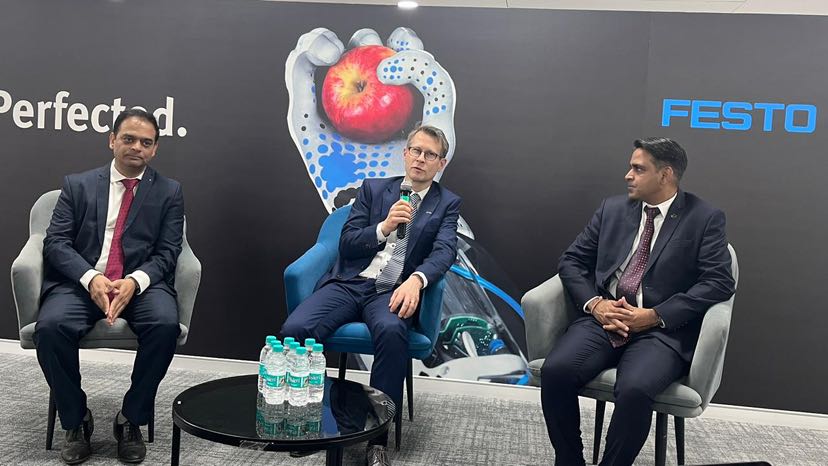
BENGALURU, February 19, 2026: German automation giant Festo officially pivoted its Indian strategy from sales to deep-tech engineering Wednesday, inaugurating a 71,000-square-foot Global Capability Centre (GCC) near Electronics City. The 100-year-old pneumatics leader confirmed it will transform the Bengaluru facility into a global innovation engine, integrating engineering, production, and shared services under one roof.
While the firm did not disclose the specific investment amount, leadership outlined an aggressive roadmap to scale the centre to 600 employees by 2030, a significant jump from its current headcount of 250. Sebastian Beck, Member of the Management Board for HR & Finance at Festo SE & Co., stated that the inauguration marks a shift toward “deeper localisation,” moving beyond a largely sales-led presence to include local sourcing and high-end manufacturing.
High-Value Growth and the AI Frontier
Reflecting 40 years of growth and achievement on his visit to India, Sebastian Beck, Member of Management Board HR & Finance, Festo, celebrated the launch of Festo GCC, “Forty years of Festo in India is a powerful reflection of our long-term vision and belief in the country’s industrial and technological potential. What began as a market presence has evolved into a strong partnership built on trust, engineering excellence, and shared values. As we look ahead, India will continue to play a strategic role in shaping Festo’s global innovation, digital capabilities, and sustainable growth.”
Alok Maheshwari, Head of GCC for Festo India, emphasized that the company is targeting 2.5x growth but cautioned that success is measured by value creation rather than raw headcount. Addressing the rise of Artificial Intelligence, Maheshwari noted that while the technology may eventually allow fewer people to generate higher output, it is unlikely to reduce staff in the near term. The firm maintains that while AI can assist in writing code, human expertise remains essential to validate and apply it within industrial contexts.
In a competitive hiring landscape dominated by Big Tech, Festo is positioning itself as a destination for impact-driven work in bionics and robotics. Beck noted that talent does not need to join firms like Google or Apple to find cutting-edge challenges, asserting that Festo offers a comparable learning experience in industrial automation. The GCC has already onboarded over 100 professionals in the past year, with 20 new hires set to join in March and over 50 positions currently open.
The centre’s primary recruitment focus remains on software and technology-led roles, specifically in electric and process automation. Unlike traditional web development, the hub is hunting for full-stack developers, data scientists, and embedded AI specialists. A key priority is the establishment of a dedicated Product Security Lab in Bengaluru, the only such facility within Festo’s global network, alongside roles for automation testing engineers.
On the sustainability front, Ravi Sastry, Managing Director of Festo India, revealed that the company’s local operations already draw 70% of their energy from solar power. The new GCC will support global R&D initiatives aimed at designing energy-efficient automation products, particularly in compressed air systems.
Strategically, Festo views India as a “natural partner” for Europe amid evolving India-EU trade discussions. Executives noted that reduced trade barriers would facilitate the free movement of goods and talent, positioning the Bengaluru GCC as both a local innovation engine and a global export hub for software and digitalisation services.