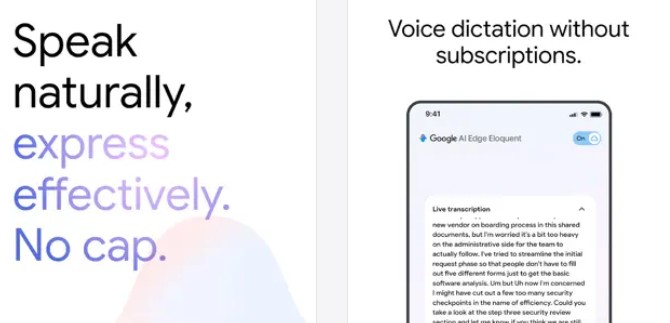
Wednesday, April 8, 2026: Google has slipped a new AI experiment into the App Store with the launch of AI Edge Eloquent, an iOS‑only dictation app built to showcase the company’s latest on‑device speech technology. The understated release puts Google in direct competition with fast‑growing transcription tools like Spokenly and Whisperflow, signaling a renewed push into the booming voice‑to‑text market.
Google’s AI Edge Eloquent focuses on offline performance, polished text cleanup, and a streamlined interface, a combination that could reset expectations for mobile dictation apps.
The app uses Gemma‑based ASR models that run locally once downloaded, allowing users to dictate with minimal latency and view live transcription in real time. When a session is paused, Eloquent automatically removes filler words and mid‑sentence corrections, producing cleaner text without requiring manual edits. Users can also apply preset transformations such as Key Points, Formal, Short, and Long to quickly reshape the output.
Google’s Offline Dictation App “AI Edge Eloquent”, Targeting Spokenly and Whisperflow in Voice‑to‑Text Space
A prominent Cloud Mode toggle in AI Edge Eloquent lets users choose between fully offline processing or enhanced cleanup via Gemini models. The app also supports custom vocabulary, Gmail‑based jargon import, searchable transcription history, and detailed session analytics including words‑per‑minute and total word count.
Google initially referenced an Android version in the App Store listing, but the company has since removed that mention. The updated listing now highlights that an iOS keyboard integration is coming soon, suggesting system‑wide dictation may be part of the roadmap.
Compared with competitors, Eloquent’s hybrid offline/online design and built‑in editing tools give it a more flexible workflow than Spokenly, while its upcoming keyboard feature could challenge Whisperflow’s floating‑button system‑wide access on Android.
As AI transcription apps continue to gain traction, Google’s move hints at broader ambitions. If Eloquent performs well, it could influence future speech‑to‑text features across the Android ecosystem.