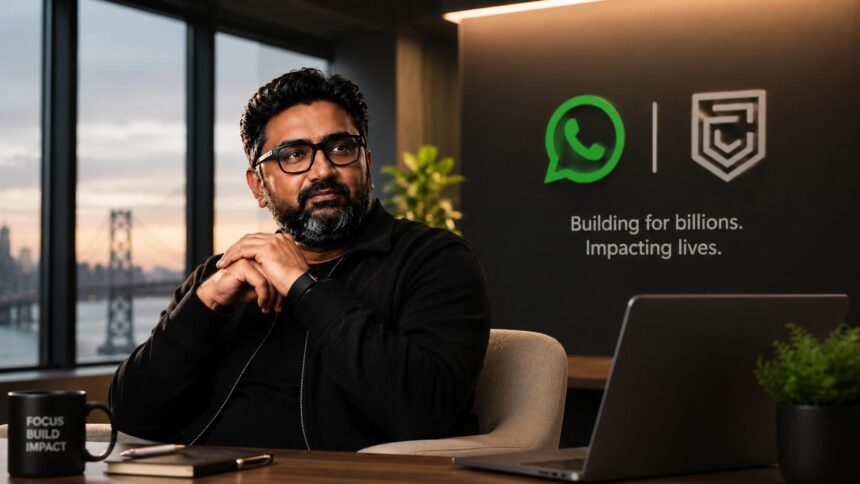
Tuesday, June 23,2026: When Meta announced that Kunal Shah would become the next head of WhatsApp, the news immediately resonated far beyond Silicon Valley.
This wasn’t just another executive appointment. It was the story of an Indian startup founder being handed responsibility for one of the world’s most influential technology products.
At the same time, Meta is investing roughly $900 million into Shah’s firm , valuing the fintech company at around $4.5 billion. Together, the two developments represent a major vote of confidence in both Shah and the company he built.
For years, Kunal Shah has occupied a unique position in India’s startup ecosystem. He built Freecharge into one of the country’s early digital payments success stories before selling it. He later launched Cred, a company that many initially struggled to understand but which eventually grew into one of India’s most recognized fintech brands.
Now, Shah is stepping away from day-to-day operations at Cred and moving to San Francisco to lead a platform used by billions of people worldwide.
The appointment comes at a crucial time for WhatsApp.
Cred’s Kunal Shah Lands Meta’s Most Powerful Roles – Whatsapp
The messaging app already dominates global communication. The challenge is no longer about getting more users. Instead, the focus is shifting toward building new businesses around messaging, payments, AI-powered interactions, and commerce while preserving the simplicity that made WhatsApp successful in the first place.
Meta appears to believe that founder-led thinking can help solve that challenge.
Unlike traditional corporate executives, founders often approach products with a long-term mindset, obsessing over customer behavior, engagement, and product-market fit. Those are qualities that helped Shah build Cred into a company with millions of users and a strong brand despite intense competition in India’s crowded fintech market.
Back in India, Kunal’s firm is entering a new phase of its own.
Leadership responsibilities will move to Miten Sampat, Shah’s long-time lieutenant. The transition will test whether Cred can continue scaling as a mature institution rather than a founder-centric startup. Investors will be watching closely as the company pursues profitability, growth, and a potential path toward public markets.
The bigger story, however, may be what this says about India’s startup ecosystem.
A decade ago, Indian founders were largely focused on solving local problems. Today, they are increasingly influencing global technology. From payments and commerce to software and AI, Indian entrepreneurs are building companies, products, and networks that attract attention from the world’s largest technology firms.
Meta’s decision to hand WhatsApp’s leadership to Kunal Shah reflects that shift.
For WhatsApp, it’s the beginning of a new leadership era.
For Cred, it’s a test of institutional strength.
And for India’s startup community, it’s another reminder that the world’s biggest technology opportunities are no longer confined to Silicon Valley.