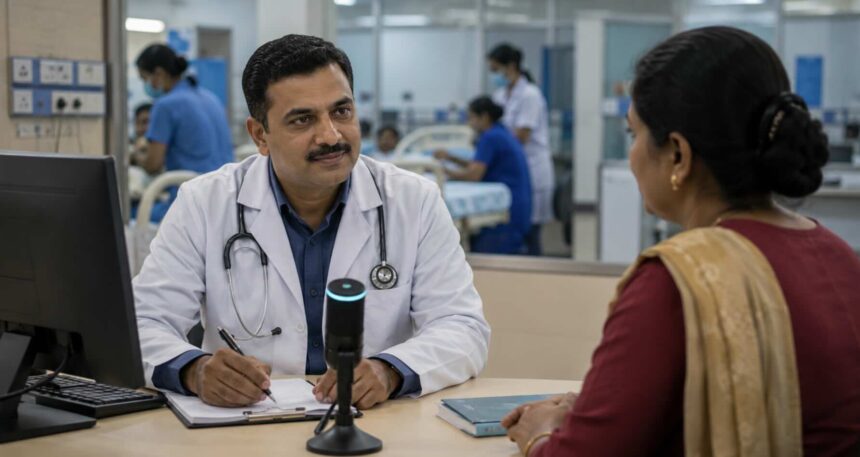
August 10, 2026, CHENNAI: For doctors in India’s government hospitals, the challenge is often not just treating patients but documenting every consultation while dealing with large patient volumes. IIT Madras startup Plenome is addressing that bottleneck with Ashwin AI, a system that converts doctor patient conversations into medical records and prescriptions.
The platform uses voice based technology to capture consultations, convert them into text and generate medical documentation. It is designed to reduce the time doctors spend taking notes, while also helping them manage prescriptions and follow up on patient outcomes.
Ashwin AI recently won BHASHINI’s national AI hackathon under its multilingual healthcare transcription and service delivery challenge. Plenome received ₹35 lakh in prize money to pilot the technology after the platform went through three stages of evaluation over the past year.
The system has already been deployed at AIIMS New Delhi and, according to Plenome, has generated more than 45,000 prescriptions. It is also being used by Apollo Telehealth and at four NIC supported hospitals across India.
“Doctors at government hospitals struggle to take notes or do follow ups due to the high volume of patients,” said Prabhu Rajagopal, director in charge, IIT M Zanzibar campus and founder of Plenome. He said the system can help doctors generate prescriptions, communicate medicines to patients and track their recovery.
A major part of Plenome’s development effort has been around Indian languages. Ashwin AI can handle consultations in languages including Hindi, Tamil, Telugu and Gujarati, with the company claiming text generation accuracy of between 90% and 95%.
That multilingual capability could be particularly relevant for government healthcare, where doctors and patients may not always use English for consultations.
IIT Madras Startup Plenome Builds AI That Turns Doctor-Patient Conversations Into Prescription
Anirudh Varna, chief technology officer at Plenome, said the system typically takes between 10 and 12 seconds to process a consultation and generate the corresponding medical records and audio files.
Plenome is now looking to take the platform into more government hospitals, with discussions planned with state governments including Tamil Nadu and Goa.
The technology is built around a decentralised machine learning approach, allowing it to be trained across multiple independent data sources without requiring large scale transfer of data. This could be important for healthcare deployments, where patient information requires careful handling.
Plenome’s work is not limited to healthcare. The company is also using the underlying technology for applications including energy metering, parole management and voice based survey reporting.
For government hospitals, however, the immediate opportunity is more practical: reducing the administrative load on doctors. If Ashwin AI can reliably turn a consultation into usable medical documentation without adding another layer of work for medical staff, its deployment could address one of the less visible pressures on India’s public healthcare system.
The next phase for Plenome will be moving beyond individual deployments and pilots to wider adoption across state run hospitals. That will put the platform’s accuracy, language coverage and ability to fit into existing hospital workflows to a much larger test.