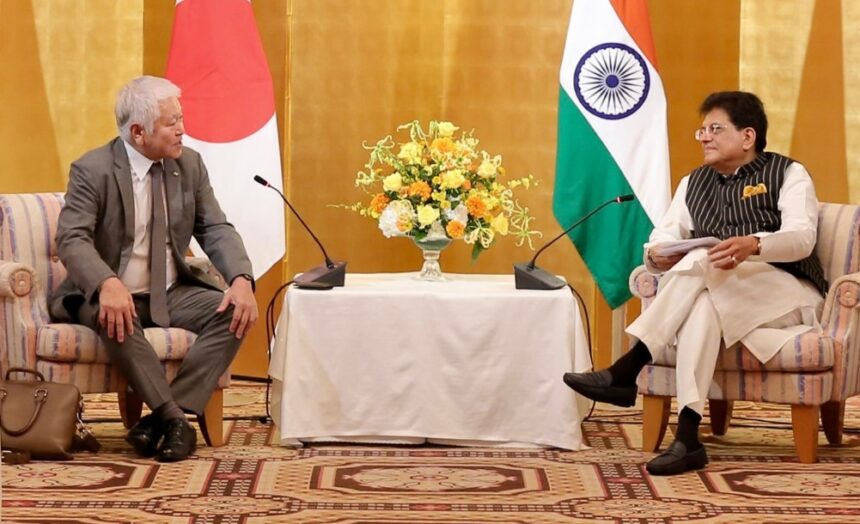
August 27, 2026: India and Japan are seeking to move their startup relationship beyond individual investments and business deals, with both sides putting greater emphasis on deep technology, advanced manufacturing, research and the ability to build companies for global markets.
At an India Japan Startup Roundtable in Tokyo on Wednesday, Commerce and Industry Minister Piyush Goyal said the partnership could become a more important channel for investment and technology collaboration as India’s startup economy moves into a more mature phase.
Goyal said India has added nearly 250,000 startups over the past decade, supported by its large domestic market, STEM talent, digital public infrastructure and expanding innovation base. The pitch to Japanese investors was increasingly centred on companies working in areas such as artificial intelligence, semiconductors, healthcare, space, defence, robotics and advanced manufacturing.
For startups, the significance of the discussions lies less in the headline number of companies and more in what the two governments are trying to build around them: access to capital, technology, manufacturing capabilities and international markets.
Goyal proposed a four part framework for closer cooperation. One element is a Japan India Deep Tech Capital Corridor intended to bring more patient capital into early research, technology development and commercialisation. Another would create an innovation bridge connecting universities, incubators, laboratories, research institutions and testing facilities in both countries.
The proposal also calls for closer integration between Indian manufacturing and engineering capabilities and Japan’s precision manufacturing expertise. A fourth component would create joint startup pitching platforms where Indian founders could regularly engage with Japanese corporations, venture funds and strategic investors.
The push comes as India’s startup ecosystem is broadening beyond its earlier concentration in consumer internet and software businesses. Investors at the Tokyo meeting pointed to manufacturing and technology intensive companies as an increasingly important part of the next phase of growth.
That shift matters for Japanese investors and industrial companies because India can offer something that many early stage markets cannot: a large domestic market in which new technologies can be tested and scaled. Japanese companies, meanwhile, can bring manufacturing experience, technology, capital and access to established global supply chains.
Piyush Goyal also highlighted a proposed second Fund of Funds of about $1 billion, with a focus on deep technology businesses, and invited Japanese investors to participate.
The existing business links between the two countries are already beginning to produce results. Indian Ambassador to Japan Nagma Mohamed Mallick said the India Japan Pitching Series has connected 65 Indian startups with about 100 Japanese corporations, leading to more than 30 business tie ups.
The scale of the latest engagement was also notable. A 222 member Indian business delegation was in Japan, creating an opportunity to build relationships across investment, manufacturing and technology rather than limiting discussions to startup funding.
Japan International Cooperation Agency Senior Vice President Shohei Hara argued that the relationship should work in both directions. Japan can contribute technology and industrial expertise, while Japanese companies can learn from Indian startups that have developed businesses around large social and developmental challenges.
JICA also plans to broaden efforts to introduce Japanese startups to opportunities in the Indian market.
Japanese investors participating in the roundtable identified artificial intelligence, semiconductors, healthcare, space, defence, advanced manufacturing and deep technology as areas with potential for greater investment. The presence of companies and investment groups including SPARX Group, MUFG Innovation Partners, Beyond Next Ventures, Incubate Fund Asia, Mizuho Financial Group, SBI Investment and Fujitsu reflected the range of financial and corporate interest.
Indian startups used the meeting to present work across aerospace and defence, drones, artificial intelligence, healthcare, prosthetics, robotics, warehouse automation, mobility and digital health.
India and Japan Put Capital, Manufacturing and Deep Technology at the Heart of Startup Push : Piyush Goyal in Japan
The potential partnerships extend well beyond investment. Startups are looking for Japanese partners that can help validate technology, improve manufacturing, enter new markets and connect them with global supply chains. For Japanese companies, Indian startups offer opportunities to access new technologies and business models while expanding their exposure to the Indian market.
A recurring issue raised at the meeting was the need to bring smaller manufacturers into this emerging ecosystem. Industry representatives called for stronger links between MSMEs, startups and global supply chains, as well as ready to use industrial infrastructure that can allow companies to begin manufacturing and expand without lengthy setup processes.
This could become one of the more consequential parts of the partnership. If startup innovation can be connected with India’s manufacturing base and Japanese industrial capabilities, the relationship could produce companies that are not simply serving the Indian market but competing internationally.
The broader policy challenge will be turning the proposed mechanisms into working channels for capital, technology transfer and commercial partnerships. Startup ecosystems rarely deepen through government announcements alone. They require investors willing to stay through long development cycles, corporations prepared to work with young companies and research institutions that can move technology from laboratories into commercial products.
India and Japan appear to be positioning their relationship around precisely that transition. The opportunity is to combine India’s scale, talent and entrepreneurial base with Japan’s technology, manufacturing capabilities and long term investment approach.
If the proposed capital corridors, innovation links and manufacturing partnerships develop as planned, the result could be a more institutional relationship between the two startup ecosystems, giving founders in both countries a route to capital, customers, technology and global markets.