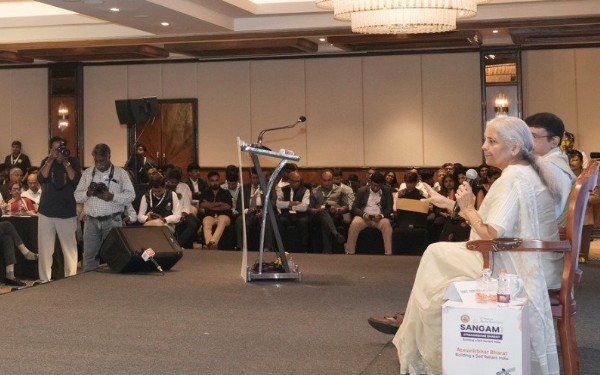
BENGALURU, September 28, 2026: Finance Minister Nirmala Sitharaman has outlined a broader economic role for India’s startup ecosystem, saying young companies could become significant contributors to the economy while urging founders to move beyond the traditional venture-capital funding cycle and consider public markets as they mature.
Speaking at the IIT Madras Alumni Association’s Sangam 2026 in Bengaluru, Sitharaman said the startup ecosystem has changed considerably since 2015 and that technologies developed by startups now need to find applications across a wider range of industries.
Nirmala Sitharaman’s comments point to a shift in how India’s startup sector is being viewed—from an ecosystem primarily associated with venture funding and high-growth technology companies to one that could increasingly contribute to industrial expansion and productivity across sectors.
Sitharaman cited agriculture and drones as examples of startup technologies that can have applications beyond their original markets. She also pointed to developments in the space sector, where private companies are increasingly involved in satellite development and space missions, while identifying defence as another area with scope for greater private investment.
The finance minister also called on technology startups to think further ahead about their capital journey. Rather than concentrating primarily on early and later-stage fundraising, founders should consider whether their companies can eventually access public markets, she said.
A larger number of listed technology and artificial intelligence companies could also provide greater visibility into India’s progress in these sectors. FM Nirmala Sitharaman said the relatively small number of AI companies listed on Indian exchanges should not be interpreted as evidence that India has missed the AI opportunity, noting that several Indian AI companies have already become unicorns or are approaching that stage.
For businesses operating in deeptech and hardware, however, the path to scale can be considerably longer than in software-led startups. Companies developing physical technologies can require years of investment before generating significant revenue, creating a need for capital that can remain invested over longer periods.
Nirmala 𝗦𝗶𝘁𝗵𝗮𝗿𝗮𝗺𝗮𝗻 𝗦𝗲𝗲𝘀 𝗦𝘁𝗮𝗿𝘁𝘂𝗽𝘀 𝗧𝗮𝗸𝗶𝗻𝗴 𝗮 𝗕𝗶𝗴𝗴𝗲𝗿 𝗥𝗼𝗹𝗲 𝗶𝗻 𝗜𝗻𝗱𝗶𝗮’𝘀 𝗘𝗰𝗼𝗻𝗼𝗺𝘆
Sitharaman sought concrete proposals from the startup ecosystem on this issue. Responding to concerns over the shortage of patient capital for hardware and deeptech companies, she asked stakeholders to define what constitutes “early” funding and what level of capital would be sufficient, and sought those recommendations within 10 days.
The funding question is becoming more relevant as India seeks to build capabilities in areas including AI, semiconductors, quantum computing and advanced hardware. Sitharaman said investment will be required not only in companies but also in the infrastructure needed to develop and deploy these technologies.
She also stressed the importance of skills and training, particularly as businesses across industries begin adopting AI. Building the supporting infrastructure and talent base, she said, will be critical to enabling wider technology adoption.
The comments underline a larger transition underway in India’s startup landscape. As the ecosystem matures, the emphasis is increasingly moving from raising successive rounds of private capital to building businesses capable of sustained commercial scale, wider economic adoption and, for some companies, eventual participation in public markets.
For policymakers, that evolution also raises questions around the availability of long-term capital, infrastructure and market access required to help capital-intensive technology businesses make that transition.