Friday, April 10, 2026: The era of “Chatterbox AI” is hitting a wall, and Alibaba knows it. While Silicon Valley remains obsessed with making chatbots more polite, the Chinese giant is executing a hard pivot. Their recent $290 million lead investment in the startup ShengShu isn’t just a venture play, it is the first major withdrawal from a staggering $53 billion (RMB 380 billion) war chest dedicated to one goal: making AI respect the laws of physics.
This isn’t just about spending money; it’s about shifting the very foundation of intelligence from text to reality.
The Simulation Shift: Why Alibaba is Trading Text for Reality
For two years, we’ve been dazzled by AI that can write essays but fails to understand that a dropped glass breaks. These “hallucinations” happen because Large Language Models (LLMs) live in a world of words, not weights.
By backing ShengShu, the powerhouse behind the Vidu video engine, Alibaba is funding a “General World Model.” Unlike a chatbot, a world model is trained to understand gravity, space, and time. It doesn’t just predict the next word; it predicts the next physical outcome.
The $53 Billion Infrastructure: The Nervous System of AGI
To move from “speaking” to “acting,” Alibaba is rebuilding its entire tech stack. That $53 billion isn’t just going to startups; it’s building the physical body for this new AI:
- The Brain: The new Qwen3.6-Plus model, integrated into their Wukong platform, is being redesigned to handle “agentic” tasks, AI that can actually execute code and navigate 3D environments.
- The Muscle: A massive new data center in Shaoguan, packed with 10,000 in-house Zhenwu AI chips, provides the sheer horsepower needed to simulate physical reality in real-time.
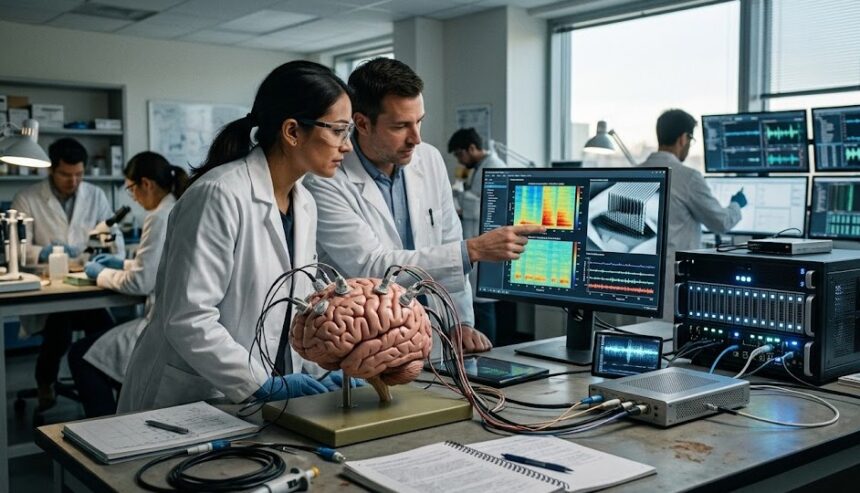
- The Link: Their quiet move into Brain-Computer Interfaces (BCI) suggests a future where these world models aren’t just on your screen, but synced with your own motor functions.
Strategic Analysis: The Three-Year Pivot (2025-2028)
| Investment Layer | The Cost | The Strategic Objective |
| The “Body” (ShengShu/Vidu) | $290 Million | Teaching AI to perceive 3D space, gravity, and touch. |
| The “Nerves” (Infrastructure) | ~$35 Billion | 10,000-card GPU clusters and proprietary Zhenwu chips. |
| The “Future” (BCI & Robotics) | ~$17 Billion | Connecting digital world models to physical hardware and human brains. |
Why This Headline Matters Now
Alibaba is trading short-term profits (which recently dipped 67% due to this spending) for long-term dominance. They are betting that the “Knowledge AI” market is already a commodity. The real value, they believe, lies in “Embodied AI”, intelligence that can drive a car, manage a warehouse, or perform surgery without “hallucinating” the physical parameters.
The $290 million check to ShengShu is the signal. The $53 billion commitment is the noise. Alibaba isn’t trying to win the argument; they’re trying to master the environment.
“The battle for who can write the best poem is over,” says trade analyst. “The battle for who can simulate the physical universe is just beginning. Alibaba has decided that if you own the physics, you own the future.”
Ultimately, this shift signals a move toward a “verifiable” digital existence. By anchoring $53 billion of infrastructure into the unyielding rules of the physical world, Alibaba is attempting to build an AI that doesn’t just mimic human conversation, but masters the human environment. If they succeed, the next generation of AI won’t just be a voice in our pockets; it will be the silent, reliable hand that moves the world around us.