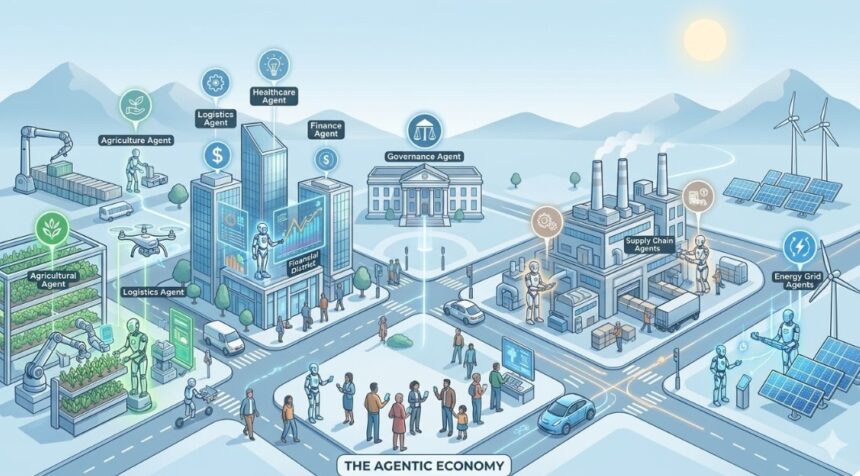
Tuesday, March 17, 2026: The latest cohort from Y Combinator (YC) has officially moved the needle from generative AI toward functional autonomy. For two decades, the accelerator has served as the primary pipeline for the SaaS era. However, the Winter 2026 batch reveals a systemic shift: founders are no longer building tools for human users, but rather the infrastructure for an “agentic” economy.
Under the current $500,000 investment model, YC is vetting a generation of startups that treat AI agents as the primary workforce. This shift suggests that the “Class of 2026” is prioritizing reliability and integration over mere content generation.
21 Disruptors: How Y Combinator’s Latest Batch is Automating the Expert Economy
The primary bottleneck for AI adoption in 2025 was “hallucination” and lack of agency. This batch addresses those gaps with dedicated infrastructure.
- Training & Testing: Polymath is deploying simulated environments where agents can “fail fast” and learn complex workflows, ranging from software deployment to team collaboration—before touching live production data.
- Performance Optimization: Compresr is solving the cost-and-confusion problem of “large context windows.” By creating an API that distills information for LLMs, they allow agents to perform technical tasks with higher accuracy and lower token consumption.
- Self-Healing Systems: Companies like Moda and Corelayer are introducing the “AI on-call engineer.” These platforms monitor autonomous software in real-time, debugging and resolving system failures without human intervention.
A notable trend in this batch is the migration of AI into highly regulated and physical sectors.
In banking, Fenrock AI is automating back-office underwriting and compliance, tasks that traditionally bottlenecked loan processing for months. In the physical world, RoboDock is tackling the “infrastructure gap” for autonomous vehicle (AV) fleets. While cars can drive themselves, they cannot yet charge or inspect themselves; RoboDock’s robotic depots aim to remove the final human requirement in fleet management.
The batch of Y Combinator also features a subset of “frontier” startups that expand the definition of a Silicon Valley venture. GRU Space (Galactic Resource Utilization) is actively developing the lunar infrastructure necessary to turn Moon regolith into construction materials. This signals a move from “transportation-focused” space tech to “habitation-focused” economics, aiming to solve the problem of how humans live once SpaceX gets them there.
This batch from Y Combinator marks the end of the “AI as a Chatbot” era. We are seeing the rise of the “AI Employee”, fully permissioned, integrated, and autonomous. For investors, the value proposition has shifted from how much time a human can save to how much work a machine can do alone.