
December 30, 2025: Scientists at the S. N. Bose National Centre for Basic Sciences in Kolkata have developed a new computational tool called PathGennie, which could help speed up the process of drug discovery. The tool, published in the Journal of Chemical Theory and Computation, aims to improve the simulation of rare molecular events that are crucial for understanding how drugs work in the body.
In drug development, one key factor is understanding how long a drug stays attached to its target protein. This “residence time” is important because it can affect the drug’s effectiveness. However, simulating this process has been difficult because the events, like a drug unbinding from its target, happen very quickly, on timescales of milliseconds to seconds. Current methods are not always accurate or efficient enough to capture these rare events.
PathGennie Simulates Drug Unbinding Without Artificial Distortions
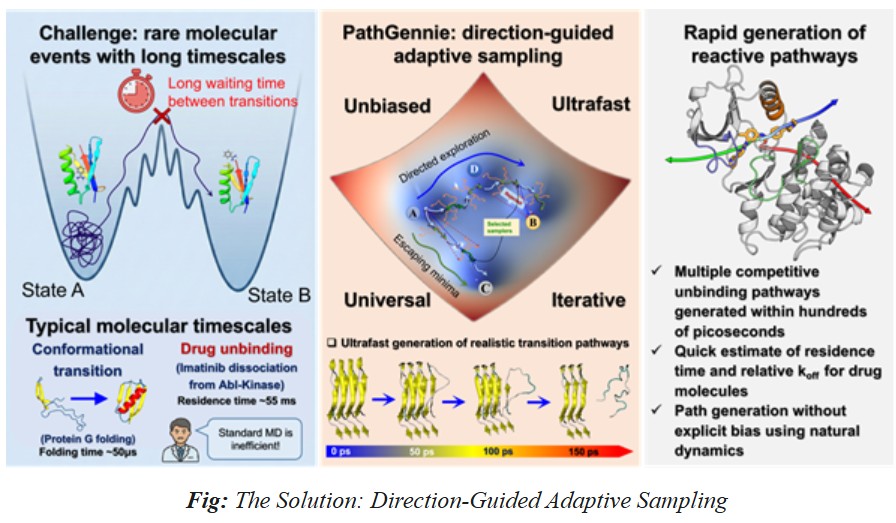
PathGennie offers a solution to this challenge. Traditional methods often use artificial forces or higher temperatures to make the drug unbind faster, but this can distort the results. Instead, the drug discovery tool works by simulating short, unbiased molecular dynamics (simulations of how molecules move over time), then selecting and extending the simulations that show progress toward the desired outcome, like a drug unbinding from its target.
This process avoids the need for external biases, allowing the simulations to stay true to natural molecular behavior. By using this method, researchers can explore molecular events that previously took too long to simulate.
In early tests, the new drug discovery tool was able to accurately predict how drugs like the anti-cancer medicine imatinib (Gleevec) unbind from its target protein, the Abl kinase. The tool identified multiple pathways the drug could take to detach from the protein, showing results that matched previous studies. This proves that the new drug discovery tool can simulate complex molecular interactions without needing artificial adjustments.
Researchers also used the tool to explore how a benzene molecule escapes from an enzyme’s binding pocket. Again, drug discovery tool showed several different possible pathways, providing insights that weren’t as clear with traditional methods.
Though PathGennie was designed to improve drug discovery, it has potential uses in many other scientific fields. The tool can be applied to other processes that involve rare events, such as chemical reactions, phase transitions, and self-assembly processes. This makes it a useful addition to many areas of research.
The tool can also be combined with modern machine learning techniques, allowing scientists to use custom parameters to guide their simulations. This adaptability ensures that the drug discovery tool can be useful for a wide variety of scientific problems.
One of the key benefits of the drug discovery tool is that it is open-source, meaning it is freely available for other researchers to use. This gives scientists around the world the opportunity to take advantage of this new method without any cost, helping to advance research in drug development and other fields.
By making the drug discovery tool accessible to everyone, the team hopes to encourage more researchers to explore and improve upon this method, ultimately speeding up scientific discoveries.
The new drug discovery tool offers a promising new way to simulate how drugs interact with their targets, especially in terms of unbinding. By providing a faster and more accurate way to study these rare events, it could help researchers develop drugs more efficiently. With its open-source release, the tool is expected to be a helpful resource for researchers in drug discovery and beyond.