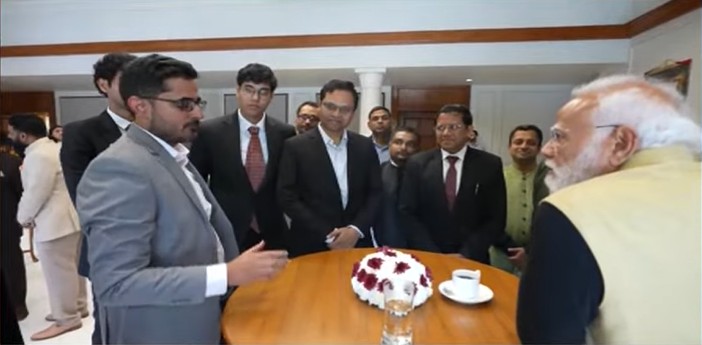
New Delhi, January 9, 2026: While the global tech discourse has long been dominated by the heavyweights of the West, a new power dynamic was codified this week at the Prime Minister’s residence. In a closed-door roundtable with 12 foundational AI startups, the conversation moved past simple digital adoption toward something far more ambitious: Technological Autonomy.
This meeting, ahead of the India AI Impact Summit 2026, served as the formal unveiling of a domestic “intelligence stack” designed to serve a billion people without relying on foreign proprietary code.
The startups in the room, ranging from those building multilingual Large Language Models (LLMs) like Sarvam and BharatGen to industrial pioneers like Shodh AI, are not merely building software; they are building a “moat.” By developing localized models that understand regional dialects and indigenous data structures, these founders are ensuring that India’s digital future is not filtered through a foreign cultural lens. Prime Minister Narendra Modi addressed these founders as “co-architects,” signaling that the government no longer views AI as a luxury service, but as the fundamental infrastructure of modern statecraft.
The Frugal AI Frontier: Why the Global South is Looking to New Delhi
The significance of this gathering lies in the birth of the “Indian AI Model“, a philosophy defined by frugal innovation and ethical transparency. Unlike the resource-heavy, high-cost trajectories of Silicon Valley, the 12 startups showcased at the summit are mastering the art of high-performance AI on lean compute budgets. This “frugal frontier” is what truly shifts the center of gravity; it makes India the primary laboratory for the Global South, offering a blueprint for nations that need AI to be an inclusive utility rather than an expensive black box.
By insisting that these models remain unbiased, ethical, and grounded in data privacy, the Prime Minister is positioning India as the “Trust Capital” of the AI world. The shift is strategic: while other nations focus on the raw power of GPUs, India is focusing on the sovereignty of the stack.
From engineering simulations for manufacturing to AI-driven healthcare diagnostics for rural clinics, the 12 startups are proving that the most resilient technology is that which is built to solve real-world friction. This collaboration marks the moment India stopped being a participant in the AI race and started becoming its most influential referee.