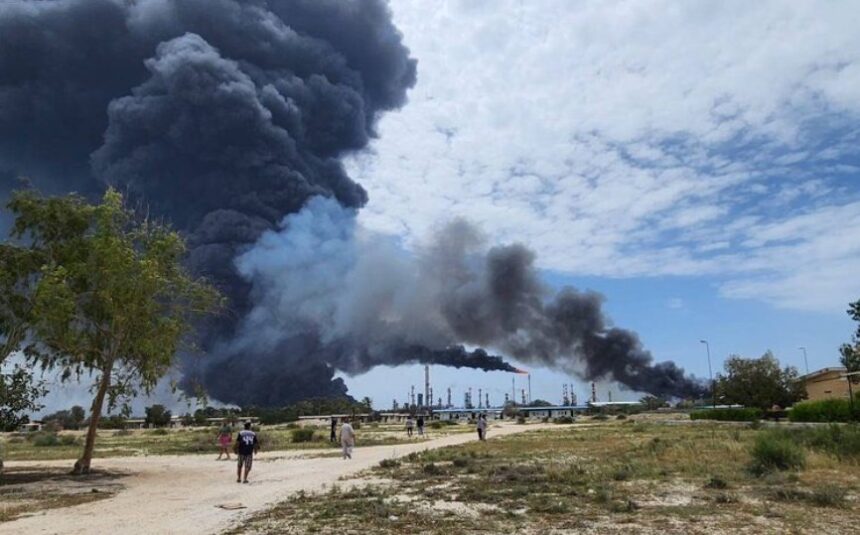
Monday, April 8, 2026: New Delhi: A reported strike on an oil refinery on Lavan Island has cast immediate doubt over the durability of a newly announced two-week ceasefire between Iran and the United States, highlighting the deep mistrust and volatility that continue to define the standoff.
According to Iran’s National Iranian Oil Refining and Distribution Company, the facility was hit around 10:00 local time in what authorities described as an “enemy attack.” While no casualties were reported, emergency teams were deployed to contain a fire triggered by the incident. Satellite imagery from NASA corroborated signs of fire on the island.
The timing of the strike is significant. It came just hours after a ceasefire, brokered to prevent further escalation, was announced following heightened tensions and threats of large-scale military action by Donald Trump. The truce was also understood to involve Israel, reflecting the broader regional dimension of the conflict.
A ceasefire under immediate strain
The agreement, framed by Washington as a strategic pause, included provisions for Iran to reopen the Strait of Hormuz, a critical artery for global oil shipments. In return, the United States committed to suspending military operations for a two-week window.
However, the refinery incident underscores a recurring pattern in geopolitical conflicts: ceasefires often halt official hostilities without fully controlling actions on the ground. Whether the strike was carried out by a state actor, proxy force, or rogue element remains unclear, but its occurrence so soon after the agreement raises questions about enforcement mechanisms and command cohesion.
Oil, geopolitics, and signalling
Lavan Island’s refinery is part of Iran’s broader energy infrastructure, making it a strategically sensitive target. Any disruption even without casualties carries symbolic weight. It signals that critical assets remain vulnerable and that deterrence, rather than de-escalation, may still be driving behaviour on multiple sides.
The reopening of the Strait of Hormuz was expected to stabilise global energy markets, which are highly sensitive to disruptions in the Gulf. Wednesday’s events, however, could reintroduce volatility if investors interpret the ceasefire as fragile or reversible.
US Iran War: Diverging narratives and unresolved tensions
President Trump has described the ceasefire as a “complete victory,” maintaining that Iran agreed to key conditions, including securing its enriched uranium during the truce. Tehran, however, has consistently denied pursuing nuclear weapons an assessment not backed by international watchdog findings.
Notably, earlier US demands such as halting uranium enrichment, limiting missile capabilities, and curbing regional proxy support do not appear explicitly embedded in the current ceasefire framework. This omission suggests the agreement may be more tactical than comprehensive, aimed at buying time rather than resolving core disputes.
Trump’s shifting rhetoric from calls for “unconditional surrender” to accepting a temporary truce also reflects the fluid nature of the situation, where strategic recalibration is ongoing.
Broader outlook
The refinery strike highlights a central reality: ceasefires in high-stakes geopolitical conflicts often serve as pauses, not endpoints. With multiple actors involved and competing strategic interests at play, even minor incidents can escalate quickly or derail diplomatic progress.
If further violations occur, the two-week window may prove insufficient to build trust or achieve meaningful de-escalation. Instead, it risks becoming another short-lived interruption in a longer cycle of confrontation.