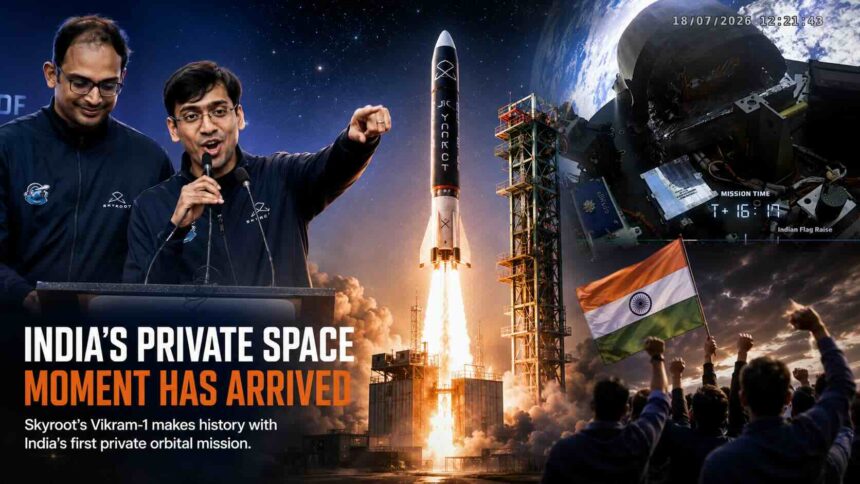
July 18, 2026, Sriharikota: Skyroot Aerospace has etched its name into India’s space history after Vikram-1 became the country’s first privately developed rocket to successfully reach orbit, marking a milestone that could redefine India’s ambitions in the global commercial space industry.
The mission, named Aagaman, represents far more than the successful launch of a rocket. It is the strongest validation yet of India’s decision to open its space sector to private enterprise, signalling that the country is moving beyond a government-led space programme towards building a competitive commercial ecosystem capable of serving customers around the world.
Until recently, India’s space achievements were almost entirely driven by ISRO, whose cost-efficient missions established the country as a respected spacefaring nation. The emergence of companies such as Skyroot marks the beginning of a new phase, where startups are expected to complement ISRO by developing launch vehicles, satellites and space technologies for commercial markets. Vikram-1 demonstrates that Indian private companies are now capable of executing one of the most technically demanding challenges in aerospace—placing payloads into orbit.
The significance of the mission by Skyroot Aerospace extends beyond engineering. The global space economy is entering a period of rapid expansion, driven by rising demand for satellite communications, Earth observation, navigation, defence applications and space-based data services. Every one of these industries depends on reliable access to space, making launch vehicles the critical gateway to a much larger commercial opportunity.
For India, this creates an opportunity to move up the value chain. While the country has long been recognised for engineering talent and cost-effective manufacturing, private launch capability allows it to compete in a market that has traditionally been dominated by a handful of established global players. As satellite constellations continue to grow and governments and enterprises seek more frequent launches, India’s ability to offer competitive launch services could become a significant strategic advantage.
The launch also reflects the broader evolution of India’s startup ecosystem. Over the past decade, venture capital has largely flowed into software, fintech and consumer technology. Space technology represents a different class of entrepreneurship, requiring years of research, advanced manufacturing, patient capital and highly specialised engineering talent. Vikram-1’s success suggests that India’s deep-tech ecosystem is beginning to mature into sectors once considered beyond the reach of private startups.
However, the success of a single mission does not automatically translate into commercial leadership. The global launch market rewards consistency, reliability and execution over time. International customers will judge launch providers on cadence, payload flexibility, turnaround time and cost competitiveness. Skyroot’s next challenge will therefore be to transition from proving technological capability to establishing a dependable commercial launch business capable of serving customers at scale.
Beyond its commercial significance, the mission also carried symbolic value. Vikram-1 flew with a handwritten message from Prime Minister Narendra Modi that simply read, “Vande Mataram,” alongside hundreds of commemorative postcards carrying wishes from people across the world. The rocket also carried the signatures of the engineers, technicians and team members who built it, recognising the people behind India’s first private orbital mission.
The successful launch is unlikely to be remembered solely because it was India’s first privately built rocket to reach orbit. Its lasting significance lies in what it enables next. If more companies follow Skyroot’s path and India succeeds in building a broader ecosystem spanning launch vehicles, satellite manufacturing, propulsion systems and downstream space applications, Vikram-1 may ultimately be seen as the mission that transformed India’s space programme into a globally competitive space economy.