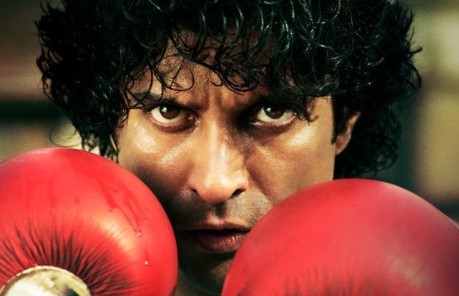
October 24, 2026: Udta Teer has an idea that could easily have turned into a fun, unpredictable spy comedy. A Pakistani agent loses his memory during a mission in India, forgets who he really is and begins working against the very people he was sent to serve. His superiors are left scrambling to control the situation, while the people around him struggle to make sense of his sudden change of character. It sounds like the perfect setup for a comedy of errors, but the film doesn’t quite know how to make the most of it.
Directed by Akash A Kaushik, known for writing Housefull 4 and the Bhool Bhulaiyaa sequels, Udta Teer starts with plenty of promise. However, as the story unfolds, the humour becomes increasingly inconsistent. There are moments when the absurdity works, but too often, the film mistakes confusion for comedy.
Ayushmann Khurrana plays Bilal Ahmed, a Pakistani agent operating in India under the identity of Vikrant Thapar. His cover includes a marriage to Yamini, played by Sara Ali Khan, who works in the finance department of India’s defence ministry. Her mother, portrayed by Supriya Pilgaonkar, is already worried about her daughter’s troubled marriage. Things become considerably more complicated when Bilal suffers a head injury and loses his memory.
Ayushmann Does the Heavy Lifting in This Uneven Comedy in Udta Teer
Convinced that he is Vikrant, Bilal begins behaving like an Indian counter-terrorism operative. His Pakistani handlers, General Mir (Gulshan Grover) and Niyazi (Ram Kapoor), are horrified as their carefully planned operation slips out of their control. Their attempts to fix the mess provide some amusing moments, but the screenplay rarely sustains the humour for long.
Khurrana is easily one of Udta Teer’s strongest assets. He seems comfortable playing a man who has no idea who he is or why everyone around him appears so agitated. His performance brings a certain charm to the character, and he manages to keep things interesting even when the writing starts to run out of steam. He has played several unconventional characters over the years, and Bilal fits comfortably into that list.
The supporting cast does its best with the material. Gulshan Grover and Ram Kapoor have fun playing officials who are increasingly desperate to contain the damage. Suhail Nayyar, as another operative working undercover within India’s counter-terrorism setup, adds to the confusion. Mukul Dev also makes an impression in his final screen appearance, playing a bumbling terrorist whose plans rarely go the way he expects.
Sara Ali Khan, on the other hand, doesn’t get much to work with. Yamini could have been an interesting character in a story built around mistaken identity and an increasingly chaotic marriage, but she remains largely on the sidelines. The film rarely gives her enough space to become more than a supporting presence in Bilal’s story.
The bigger problem is the writing. Udta Teer wants to be a broad spy spoof, drawing humour from the contrast between a serious espionage mission and an agent who can no longer remember what he is supposed to do. Yet the jokes often feel forced, and several situations drag on without delivering the laughs they promise.
Udta Teer keeps moving, but movement alone cannot compensate for a screenplay that lacks sharper comic timing.
One scene involving Bilal’s assumed Hindu identity and his ability to read Urdu is particularly awkward. The joke relies on a simplistic assumption about religion and language, making it feel more ignorant than funny. For a film that depends so heavily on humour, moments like this are difficult to overlook.
The movie also struggles to establish a consistent tone. At times, it behaves like a conventional espionage thriller; at others, it throws logic aside in favour of exaggerated situations. A successful spoof can get away with almost anything when the writing is sharp enough, but Udta Teer doesn’t always have that advantage. The comparison with Hollywood spy parodies only highlights how much more focused the film could have been.
Still, the film isn’t a complete disappointment. Khurrana’s performance, the supporting actors’ enthusiasm and a few genuinely amusing situations make it watchable. Those looking for a light entertainer may find enough to enjoy, provided they don’t expect a steady stream of laughs or a particularly clever take on the spy genre.
Ultimately, Udta Teer is one of those films where the premise sounds better than the finished product. It has a capable lead actor and an idea with comic potential, but the writing never quite brings everything together. Khurrana keeps the film afloat for much of its runtime, yet the comedy remains too uneven to leave a lasting impression. The spy may lose his memory, but audiences might find themselves wondering why the film couldn’t do more with such a promising setup.