Nvidia News, November 24, 2026: Nvidia’s board has reversed one of its most consequential leadership decisions in just 11 days, bringing Jensen Huang back as president and chief executive officer after his abrupt resignation on November 12. The speed of the reversal is remarkable. What makes it more significant, however, is the sequence of events that led to it. This was not simply a board reconsidering its position after a period of reflection. It was a corporate decision shaped by investor anxiety, employee support, political intervention and the extraordinary strategic importance of Nvidia to the United States.
When Huang stepped down, Nvidia appointed its chief financial officer, Colette Kress, as interim CEO and indicated that it would begin looking for a permanent successor. The departure followed reports concerning Huang’s personal relationships, including an alleged relationship with Alice Huang, a Chinese businesswoman reportedly suspected by US intelligence sources of having links to Chinese intelligence. There were also wider questions surrounding Nvidia’s business relationships, advanced chip exports to China and the possibility that restricted technology had reached unauthorised customers. These allegations remain subject to investigation, and suspicion should not be confused with established wrongdoing.
The board initially appeared determined to establish distance between the company and the controversy. On November 17, its chairman, Harvey C. Jones, indicated that there were no plans to reinstate Huang, despite the former CEO expressing his willingness to return. That position lasted less than a week. On November 23, the same board unanimously approved his reinstatement, saying that discussions with Huang had satisfied directors about his candour and ability to lead the company. It also said that input from senior US government officials gave it confidence that his return posed no national security risk.
The question is what changed so dramatically between November 17 and November 23.
The answer appears to lie in the convergence of three powerful interests. First, Nvidia’s dependence on Huang is considerably greater than the conventional relationship between a company and its chief executive. He is its co-founder, public face, chief strategist and the executive most closely associated with its transformation into the central supplier of computing infrastructure for the artificial intelligence industry. His departure created uncertainty at a company whose decisions influence technology investment, semiconductor supply chains and the global AI race. Finding a replacement capable of commanding the same confidence across employees, customers, investors and governments would have been an enormous undertaking.
Second, the reaction from within the technology industry made the board’s position increasingly difficult to sustain. Employees, investors, business partners and prominent technology figures publicly supported Jensen Huang‘s return. An online petition attracted substantial backing, while influential voices in Silicon Valley argued that Nvidia needed its founder at the helm. The message was straightforward: whatever the concerns surrounding Huang’s personal conduct, the business consequences of keeping him away from the company could be considerable.
Third, and perhaps most consequentially, Washington entered the picture.
Trump, Nvidia and Jensen Huang: A Comeback Beyond the Boardroom
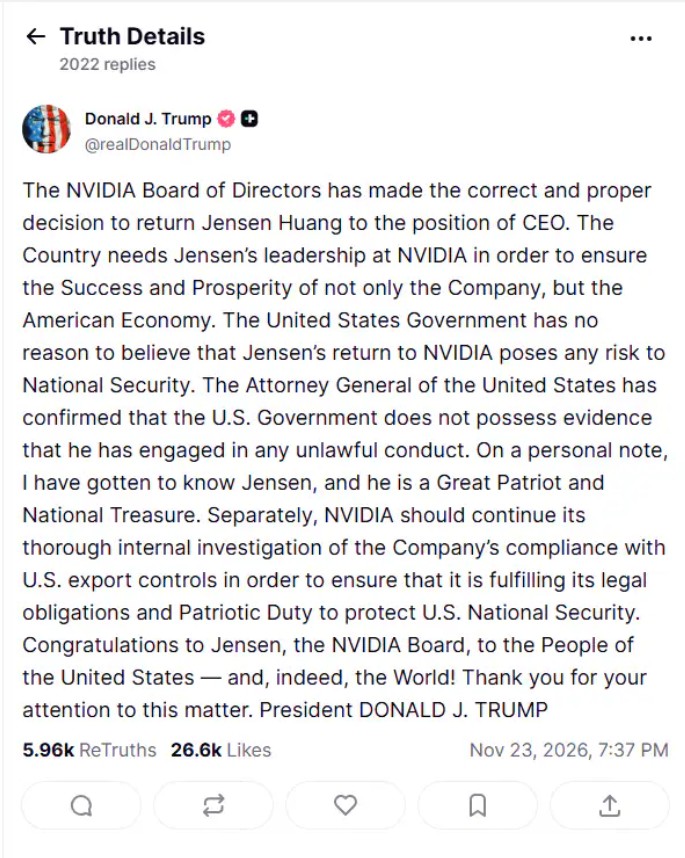
President Donald Trump openly supported Huang’s return after the resignation. His administration’s interest was hardly surprising. Nvidia sits at the intersection of artificial intelligence, national security, semiconductor manufacturing and the increasingly complicated technology relationship between the United States and China. The company is more than a successful chipmaker. Its technology is an important component of America’s ambitions to maintain leadership in advanced computing.
Trump subsequently told CNBC that he had spoken to Nvidia’s board, directly and indirectly, and believed his intervention had been important. He also said he had spoken to the board about bringing Huang back. Reports by Semafor indicated that Trump had even joined an Nvidia board meeting by telephone to make the case for the CEO’s reinstatement. The president later described the board’s decision as the correct one.
That admission changes the character of the story. It raises a much larger question about the relationship between political power and corporate governance in an industry that has become central to national economic and security interests.
A company’s board is expected to make decisions independently, assess management risks and protect shareholders over the long term. Political leaders can certainly express views about companies whose operations affect national interests. Government input on export controls, security clearances and regulatory matters is entirely legitimate. The more difficult issue arises when a sitting president publicly claims a decisive role in determining who should lead a publicly listed company.
The distinction between government oversight and government influence over corporate appointments deserves serious attention. If political access becomes an important factor in determining the future of a chief executive, the independence of corporate boards risks becoming less meaningful. The concern is particularly relevant when the company involved is one of the most valuable and strategically important businesses in the world.
Nvidia’s board now faces a second challenge. Reinstating Huang does not bring the underlying investigations to an end. The company has confirmed that its independent director committee will continue investigating reports that Huang was targeted by a foreign intelligence operation. It has also established a separate National Security and Export Control Committee, begun engaging specialist legal advisers and announced plans to appoint a chief compliance officer. Government inquiries will continue.
These measures are important because the controversy is larger than the personal conduct of one executive. It touches on the security of corporate information, export control compliance, the responsibilities of senior management and the ability of a global technology company to protect its business from geopolitical risks.
There is also an uncomfortable governance question. If the board believed Huang’s resignation was necessary on November 12, what new evidence or assurance justified reversing that decision on November 23? The company has referred to discussions with Huang and government input, but the precise basis for the reversal has not been fully explained publicly. A unanimous vote establishes the board’s agreement. It does not, by itself, establish that the process was sufficiently independent or that all the concerns have been resolved.
The market’s response tells another part of the story. Nvidia shares surged following the announcement, reflecting investor relief at the return of a leader closely associated with the company’s growth and AI strategy. The reaction demonstrated how heavily market confidence was tied to Huang’s presence. However, a rising share price is not evidence that corporate governance concerns have disappeared. Markets can reward certainty in the immediate term while overlooking risks that may take months or years to emerge.
There is a historical parallel with the dramatic return of Sam Altman to OpenAI in 2023, following his brief removal and a revolt among employees. In both cases, the organisation discovered that removing a powerful founder could be considerably more complicated than the boardroom decision itself. Yet Nvidia’s circumstances carry an additional dimension. The intervention of a sitting US president, the national security implications of advanced chip exports and the geopolitical competition with China make this episode far more than an internal corporate dispute.
What happened at Nvidia in 11 days is therefore worth examining beyond the extraordinary comeback of Jensen Huang. A board made a decision, faced mounting pressure from several directions and reversed its position. The company regained its most influential leader, investors welcomed the certainty and the administration secured a public outcome it had actively encouraged.
Yet the unresolved questions remain. Can a board exercise independent judgement when the chief executive is indispensable to the business and enjoys direct support from the White House? Can a company credibly investigate national security concerns while restoring the executive at the centre of the controversy? And where should the line be drawn between a government’s legitimate interest in a strategic industry and its influence over the leadership of a private corporation?
Huang is back at Nvidia. The real test begins now. His return may restore confidence in the company’s immediate leadership, but it also places greater responsibility on the board to demonstrate that accountability, compliance and independent oversight still matter. For a company helping shape the next industrial era, that may prove to be a far more important measure of leadership than the speed of its CEO’s return.