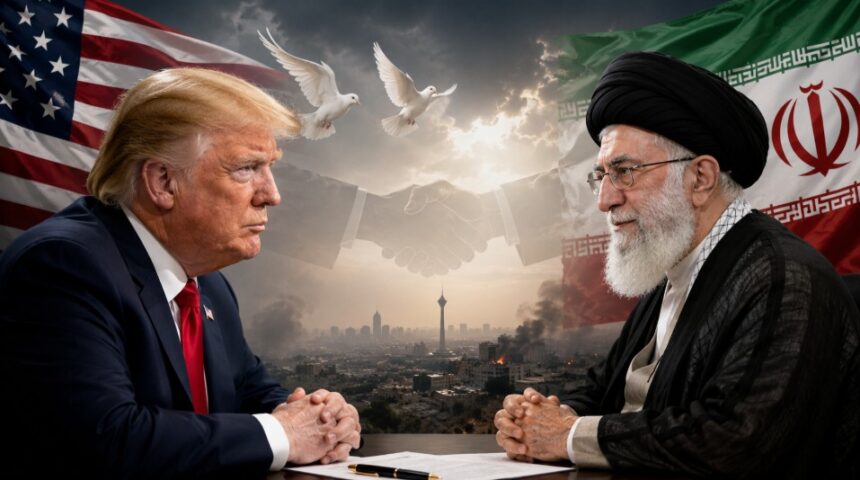
Thursday, June 18, 2026: After months of US-IRAN military escalation, economic disruption, and fears of a wider regional war, Washington and Tehran have unveiled the outlines of a 14-point memorandum of understanding that could become the foundation of a broader peace settlement.
While the agreement stops short of a final treaty, its significance lies in what it reveals: both sides appear to be stepping back from maximalist positions that only weeks ago seemed non-negotiable.
For ordinary observers, the document can be distilled into four major themes: ending military escalation, stabilizing energy routes, containing the nuclear dispute, and reopening Iran’s economy.
Yet beneath the diplomatic language, significant contradictions remain unresolved.
The US-Iran Deal: Ending a War or Delaying the Next One?
The agreement’s opening commitment calls for the immediate end of military operations, including in Lebanon.
On paper, this sounds like a breakthrough. In practice, it may be the most difficult provision to implement.
The central problem is simple: neither Israel nor Hezbollah signed the agreement.
Washington and Tehran can pledge restraint, but the actual conflict in Lebanon involves actors who are not party to the deal. Israel continues to maintain military positions inside Lebanese territory and has repeatedly stated that it intends to keep security zones along its borders.
For Iran, Lebanon has become a negotiating red line. Tehran has consistently argued that any wider regional settlement must include an end to Israeli military operations there.
The result is a diplomatic paradox. The agreement seeks peace in Lebanon without directly involving the two forces doing the fighting.
That makes this section less of a ceasefire and more of a political framework whose success depends on future negotiations.
Regime Change Is Quietly Off the Table
Perhaps the most consequential shift is not military but political.
The memorandum commits both sides to respecting each other’s sovereignty and refraining from interference in internal affairs.
In diplomatic language, this is significant.
For years, many Iranian leaders viewed American policy as ultimately aimed at regime change. Meanwhile, some voices in Washington openly argued that pressure on Tehran should culminate in political transformation.
This clause suggests both sides are moving away from that objective.
For the Trump administration, it represents an acknowledgment that overthrowing Iran’s government is neither realistic nor necessary for achieving core strategic goals.
For Tehran, it provides a measure of security that future negotiations will focus on behavior rather than leadership.
In geopolitical terms, this may be the first major sign that Washington is shifting from confrontation toward containment.
The Strait of Hormuz: Where the Real Economic Battle Lies
The most immediate global impact of the agreement concerns the Strait of Hormuz.
Nearly every major economy has a stake in what happens here because a significant portion of the world’s oil and gas exports passes through this narrow waterway.
The memorandum outlines two major steps:
- The United States would gradually end its naval blockade.
- Iran would facilitate safe passage for commercial shipping.
For global markets, this is potentially the most important element of the deal.
The conflict transformed Hormuz from a commercial shipping lane into a geopolitical choke point. Insurance costs surged, shipping schedules were disrupted, and energy markets faced renewed uncertainty.
However, a major dispute remains unresolved between US-Iran.
Iran appears determined to maintain some level of authority over future maritime services in the strait. Western governments, meanwhile, insist that international waterways cannot become revenue-generating tools for any single country.
In other words, the shooting may stop, but the struggle over who controls the region’s most strategic trade corridor is far from over.
The Nuclear Compromise Emerging in Plain Sight
The uranium section may ultimately become the heart of the agreement.
For years, negotiations have stalled over a simple question: what should happen to Iran’s enriched uranium stockpile?
The United States wanted the material removed. Iran refused.
The new language suggests both US-IRAN may have found a middle path.
Rather than exporting the uranium, Iran could dilute it to lower enrichment levels under international supervision. This process, known as downblending, would make the material unsuitable for weapons development while allowing Iran to preserve its civilian nuclear programme.
Politically, this gives both sides something they can claim as a victory. Washington can argue that the immediate proliferation risk has been reduced.
Tehran can argue that it protected national sovereignty and retained its nuclear infrastructure. This may be the most practical compromise produced by years of deadlock.
US-IRAN The $300 Billion Reconstruction Gamble
One of the most surprising elements is a proposal for at least $300 billion in reconstruction and economic development support.
The figure is extraordinary.
To put it in perspective, it would rank among the largest economic recovery initiatives associated with any modern geopolitical settlement.
Yet the proposal raises more questions than answers.
Who pays? How will funds be distributed? What oversight mechanisms will exist?
The agreement offers few specifics.
Gulf states are widely expected to play a major role, but none have publicly committed to financing such an ambitious programme.
Without clear funding commitments, this provision n the US-Iran deal remains more aspirational than operational.
US-IRAN Deal: Sanctions Relief Could Be Tehran’s Biggest Victory
If implemented, the sanctions clause could reshape Iran’s economy more than any other section.
Decades of sanctions have restricted investment, frozen assets, limited trade, and constrained economic growth.
Removing those barriers would unlock billions of dollars and potentially reintegrate Iran into regional and global markets.
From Tehran’s perspective, this is arguably the most valuable outcome of the negotiations.
From Washington’s perspective, sanctions relief becomes the primary leverage mechanism for ensuring Iranian compliance with the agreement.
The challenge will be sequencing: determining which sanctions are lifted, when they are lifted, and what benchmarks Iran must meet in return.
The Bigger Picture that explains US-IRAN Deal
This memorandum is not a peace agreement. It is a framework designed to stop a dangerous escalation and create space for future negotiations.
Its significance of the US-Iran deal lies less in what it solves and more in what it signals.
The United States appears willing to abandon regime-change rhetoric.
Iran appears willing to accept unprecedented nuclear oversight.
Both sides appear prepared to reduce military pressure in exchange for economic and strategic gains.
But the document also leaves critical questions unanswered: Lebanon remains unresolved, Israel’s position is unclear, the future of Hezbollah is unaddressed, and control of the Strait of Hormuz remains contested.
The US-Iran agreement may therefore represent not the end of a conflict, but the beginning of a new phase, one where diplomacy replaces missiles, yet rivalry continues beneath the surface.
For global markets, energy consumers, and regional governments, the real test will not be what was signed this week. It will be whether these 14 points survive contact with the realities of Middle Eastern politics.