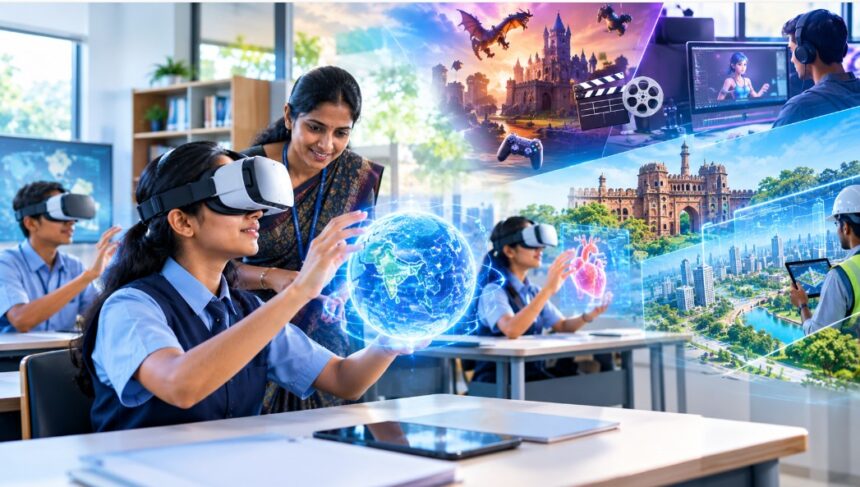
October 26, 2026: India is stepping up efforts to build its extended reality (XR) ecosystem, with a ₹250 crore allocation in the Union Budget 2026–27 for content creator labs in 15,000 secondary schools and 500 colleges. The initiative adds an education and skills-development dimension to the country’s wider push to expand animation, visual effects, gaming, comics and immersive technology.
For startups developing virtual reality (VR), augmented reality (AR), mixed reality (MR) and digital content products, the investment could help widen the talent pool and introduce more students to the tools used across the industry. The longer-term opportunity will depend on how effectively the initiative connects classroom training with the skills companies need and the products customers are willing to buy.
The Indian Institute of Creative Technologies (IICT), Mumbai, will serve as the nodal agency for planning, coordinating and implementing the content creator lab initiative. The labs are intended to give students practical experience in animation, visual effects, gaming and digital content creation, helping prepare them for careers in India’s expanding creative economy.
The move comes as immersive technology finds applications beyond gaming and entertainment. VR can place users inside simulated environments, while AR overlays digital information on the physical world. MR allows digital objects to interact with real-world surroundings. Together, these technologies are creating opportunities in education, healthcare training, tourism, retail, industrial simulation and infrastructure planning.
India’s immersive technology market generated an estimated $1.26 billion in revenue in 2023 and is projected to reach $7.82 billion by 2030, growing at a compound annual growth rate of 29.8%, according to the market figures cited in the source material. The country is also projected to be the fastest-growing regional market in Asia-Pacific.
For startups, the forecast points to a market that extends well beyond consumer applications. Businesses can develop immersive learning platforms, virtual training environments, AR-based retail tools, digital heritage experiences and software for visualising buildings or infrastructure. However, the ability to turn these applications into sustainable businesses will depend on customer demand, pricing and the practical value they deliver.
India Bets on XR, Targets 15,000 School Labs
The ₹250 crore education push is one part of a broader effort to strengthen India’s Animation, Visual Effects, Gaming, Comics and Extended Reality (AVGC-XR) sector. The Ministry of Information and Broadcasting is promoting the ecosystem through initiatives focused on skills, industry development and creative technology.
IICT, established in 2025 as a National Centre of Excellence, is working with global technology companies, including Google, Meta, Adobe and Netflix. As of March 2026, the institute had introduced 18 courses across AVGC-XR domains, with more than 135 students enrolled.
The institute’s role is significant because immersive technology combines creative production with technical capabilities. Developing an effective XR product can require software engineering, three-dimensional design, animation, spatial computing and an understanding of how users interact with digital environments. A broader training network could help startups find people with these skills, although the impact will depend on the quality of instruction and how closely courses match industry requirements.
Startup support programmes are also contributing to the ecosystem. The Ministry of Electronics and Information Technology’s GENESIS scheme aims to support around 1,600 technology startups over five years, with a focus on businesses in Tier-II and Tier-III cities. According to the source material, 84 AR/VR startups are supported through the MeitY Startup Hub, alongside 106 incubators.
WaveX, a media-tech startup accelerator and incubator launched by the Ministry of Information and Broadcasting, supports startups working in AVGC-XR and other emerging media technologies. Such initiatives can help founders develop products, access industry networks and explore commercial opportunities. Yet incubation and policy support are only part of the equation; companies still need paying customers and business models that can sustain growth.
Education itself could become an early application area for immersive technology. Researchers at IIT Madras are developing AR- and VR-enabled learning solutions for rural schools, with applications across subjects including history, science, social science and languages. Virtual environments can allow students to explore concepts through simulations rather than relying solely on textbooks and two-dimensional illustrations.
For startups entering this market, affordability and ease of deployment will be important. Schools may face limitations in equipment, connectivity and technical support. Products that work on widely available devices and fit existing classroom practices could have an advantage over solutions requiring expensive headsets or complex installations.
Tourism and cultural heritage offer another area for development. The government has used JATAN software to digitise museum artefacts and their records. Eight national-level museums and two Archaeological Survey of India museums have been digitised, according to the source material, with collections available through the Museums of India digital repository.
The Indian Museum in Kolkata has introduced AI-based interactive features and AR tools and collaborated with Google Arts & Culture on a virtual exhibition. Mobile-based virtual tours are also available at Archaeological Survey of India museums in Hampi, Karnataka, and Nalanda, Bihar. These projects point to potential demand for startups developing virtual exhibitions, interactive visitor guides and digital reconstructions.
Immersive technology is also being explored in infrastructure planning. The Department of Telecommunications’ Sangam: Digital Twin initiative combines digital twin technology with 5G, the Internet of Things and AI. Digital twins create virtual representations of real-world objects, systems or places, allowing users to examine conditions and assess possible changes.
The Varanasi Urban 3D Spatial Planning project is one example of digital twin mapping in urban development. A Mobility Digital Twin showcased at India Mobile Congress 2025 used telecom-derived mobility data to study movement patterns, including commuting and metro station catchment areas in Delhi, as well as tourist flows in Ayodhya.
For startups, these applications create opportunities in geospatial software, simulation tools, spatial data visualisation and urban analytics. The commercial challenge is to demonstrate that the technology improves decisions or reduces costs, rather than simply producing a detailed digital model.
State governments are also working to attract investment and build talent in the AVGC-XR sector. Karnataka’s AVGC-XR Policy 3.0 supports skills, infrastructure and production, while its KITVEN AVGC Fund has a ₹20-crore corpus for investments in relevant companies. Maharashtra’s AVGC-XR Policy 2025 outlines a financial plan of ₹3,268 crore, while Telangana has developed an AVGC and gaming ecosystem around Hyderabad. Tamil Nadu’s 2026 policy targets more than 200 startups and around two lakh jobs.
The growing number of state-level initiatives could give startups more options for accessing talent, infrastructure and industry networks. Their effectiveness, however, will depend on implementation and whether businesses can convert available support into commercial activity.
The sector will also feature at the Emerging Science, Technology and Innovation Conclave (ESTIC-2026), scheduled for October 27–29 at Bharat Mandapam in New Delhi. Organised by the Council of Scientific & Industrial Research, the event includes “Immersive Tech: Generative XR and Spatial Computing” among its 12 thematic areas.
India’s ₹250 crore education initiative addresses one of the foundations needed to build a stronger XR industry: access to skills and creative technology training. But a larger talent pool will need to be matched by business demand, industry collaboration and opportunities for startups to bring products to market.
The next measure of progress will be whether the investment helps students develop industry-relevant skills, gives companies access to qualified talent and supports the creation of immersive technology products that find customers in India and overseas.