May 3, 2026: April 2026 has marked a pivotal transition for the Indian Tech startup ecosystem, moving away from the era of “growth at all costs” toward a ruthless Efficiency Mandate. While the headline numbers show a slight cooling in venture capital, falling to $865 million from March’s $948 million, the underlying narrative is one of a sector undergoing a forced maturation. Driven by a “compliance-first” regulatory environment and a global workforce pivot toward Artificial Intelligence, the landscape is being redrawn for a new generation of IPO-ready, lean organizations.
The “cautious optimism” currently pervading the market is best exemplified by the thawing IPO pipeline. For the first time in 2026, a major tech-led lender has tested the public markets. OnEMI Technology Solutions (Kissht) opened its ₹926 crore IPO on April 30, with a valuation of ₹2,881 crore at the upper price band.
Unlike previous cycles where capital was used for aggressive customer acquisition, Kissht’s strategy is surgically precise: ₹637.5 crore of the fresh issue is earmarked specifically to bolster the capital base of its NBFC subsidiary, Si Creva. This shift, moving from burn-heavy distribution to capital-efficient book building, is a blueprint for other IPO-bound firms like Zepto, Acko, and Rentomojo.
The Regulatory Guardrails: RBI’s “Clean-Up” Operation
If the IPO market is the “carrot” for mature startups, the Reserve Bank of India (RBI) has firmly applied the “stick” to ensure compliance. April 24 saw the most seismic regulatory action of the year: the cancellation of Paytm Payments Bank’s license due to persistent governance lapses.
This was not an isolated event but part of a broader structural tightening:
- Fraud Prevention: A proposed one-hour delay for UPI transfers over ₹10,000 to curb escalating digital fraud.
- Wallet Restrictions: New draft guidelines for Prepaid Payment Instruments (PPIs), impacting players like Mobikwik and Amazon Pay with stricter transaction caps.
- Asset Security: Tighter norms for gold loans have forced doorstep lending fintechs like Rupeek and Indiagold to move away from distribution models toward building their own regulated loan books.
These moves signal that the RBI is no longer just supervising entities; it is actively shaping how startups must structure their partnerships and lending models to protect the “technologically weak” from fraud.
The AI Paradigm Shift: 40,000 Roles Sacrificed for Automation in the Tech Industry
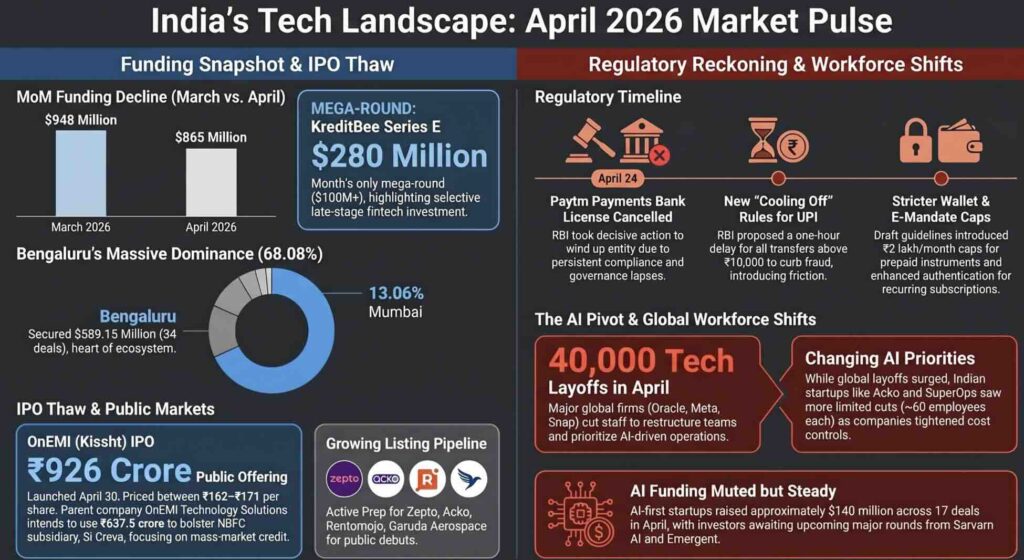
While Indian startups saw relatively muted domestic layoffs (approximately 120 employees across Acko and SuperOps), the global tech giants that anchor the Indian talent pool executed a brutal restructuring. Nearly 40,000 tech jobs were lost globally in April, a direct consequence of companies shifting capital from human workforces to AI-driven operations.
The human cost was felt most acutely at Oracle, which cut 30,000 global roles, including a staggering 12,000 in India. Simultaneously, Meta reduced its workforce by 10% (8,000 employees), and Microsoft offered voluntary retirement to over 8,700 staff members. These are not mere “cost-cutting” measures; they are strategic re-alignments as big tech prioritizes the “future of computing” via AI over traditional workforce expansion.
Bengaluru’s Dominance and the “Selective” VC Market
Funding has become highly selective, focusing on “essential” tech:
- Fintech Resilience: Led the charts with $363.8 million (42% of total), anchored by KreditBee’s $280 million Series E.
- The AI Wave: Despite global layoffs, 17 AI-first startups raised nearly $140 million, with investors betting on automation tools like Noon and Nava.
- Profitable Manufacturing: Zelio E-Mobility showcased a different path to success, reporting a 77% revenue jump and appointing Divyanshu Agarwal as CEO to lead its expansion across 23 states.
April 2026 has proved that the “Startup Winter” has evolved into a “Startup Seasoning.” The ecosystem is being seasoned by regulatory fire and AI-driven efficiency. Success is no longer measured by the size of the funding round, but by the ability to navigate the RBI’s tightening grip and the public market’s demand for capital-efficient growth.