Tuesday, May 5, 2026: The 2026 Assembly Elections have delivered a seismic shift in India’s regional political landscape. As of May 5, 2026, the counting of votes from yesterday’s results has solidified major upsets, historic breakthroughs, and the arrival of new power centers.
Here is a comprehensive summary of the news reports surrounding the four major state elections.
West Bengal: The Fall of the TMC Bastion
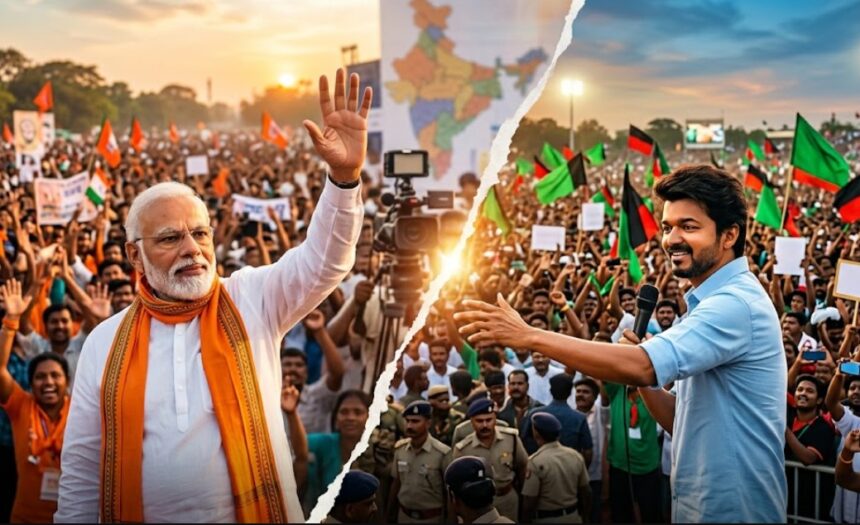
In what is being described as the biggest political upset of the decade, the Narendra Modi led Bharatiya Janata Party (BJP) has unseated the Trinamool Congress (TMC), ending Mamata Banerjee’s 15-year tenure.
- The Numbers: The BJP comfortably crossed the halfway mark, securing 206 seats out of 293. The TMC was reduced to just 80 seats.
- Key Highlights: Mamata Banerjee’s party saw a significant erosion in its traditional social coalitions. While the BJP consolidated the anti-incumbency vote, the Congress also saw a modest “vacuum-effect” revival in pockets like Murshidabad, winning seats like Farakka and Raninagar.
- Current Status: While the BJP prepares for government formation, opposition leaders like Rahul Gandhi have alleged electoral subversion, though the Election Commission has upheld the results. Repolling is scheduled for the Falta seat on May 21 due to reported irregularities.
Tamil Nadu: The Rise of a New “King”
Tamil Nadu has witnessed a historic break from the traditional DMK-AIADMK duopoly with the stunning performance of actor-turned-politician Vijay and his party, Tamilaga Vettri Kazhagam (TVK).
- The Numbers: The TVK emerged as the single-largest party with 108 seats, just shy of the 118-seat majority mark in the 234-member assembly.
- The DMK’s Setback: In a shocking turn, Chief Minister M.K. Stalin lost his seat in Kolathur, though his son, Udhayanidhi Stalin, managed to retain Chepauk. Stalin has conceded defeat, stating the DMK will act as an “exemplary opposition.”
- Government Formation: The state is currently in a state of political maneuvering. The Congress has expressed willingness to support the TVK to reach the majority mark, potentially ushering in the state’s first non-Dravidian-major-party government in decades.
- What Next for TVK’s Vijay?
- With 107 seats, Vijay is just 11 seats short of the 118-seat majority mark. While the DMK-led alliance and the NDA have been relegated to the background, Vijay now faces his first major test in political engineering. To form a stable government, his next moves will likely focus on three key scenarios:
- The “Small Party” Strategy: The most viable path for TVK is to woo smaller parties that were previously aligned with the DMK. The Congress (5 seats), the Left parties (4 seats combined), and the VCK hold the keys to the Assembly. Vijay’s father has already extended an olive branch to the Congress, suggesting a post-poll coalition. If Vijay can convince these “INDIA bloc” members that the DMK’s influence is fading, he could reach the magic number without needing a major rival’s support.
- A “Outside Support” Government: There is a possibility that Vijay could seek “issue-based” support from the AIADMK (47 seats) or even the NDA. However, this is risky for his brand; TVK campaigned on a platform of being a clean alternative to both major Dravidian parties. Accepting support from the AIADMK might alienate the young, anti-incumbency voters who propelled him to 107 seats.
- Tapping into Independents & Defectors: In the high-stakes environment of a hung assembly, individual MLAs from smaller regional outfits or disgruntled winners from other camps often become pivotal. Vijay’s team is likely already in talks with “neutral” winners to ensure a smooth swearing-in ceremony.
- The coming 48 hours will be a masterclass in negotiation for the actor-turned-leader. If he succeeds, he will become the first non-DMK, non-AIADMK Chief Minister of Tamil Nadu since 1967, effectively ending a 60-year political era
Kerala: UDF Returns After a Decade
Kerala has maintained its “swing” tradition, rejecting the LDF’s bid for a third consecutive term and favoring the United Democratic Front (UDF).
- The Numbers: The Congress-led UDF has crossed the majority mark of 71 seats, securing a clear path to power.
- Historic BJP Inroads: For the first time in Kerala’s history, the BJP won 3 Assembly seats (Nemom, Palakkad, and Kazhakoottam), marking a significant psychological victory for the party in the southern state.
- The LDF’s Exit: Chief Minister Pinarayi Vijayan faced a tough battle in his stronghold of Dharmadom; while he eventually took a lead, the overall LDF performance suffered from heavy anti-incumbency after 10 years in power.
Assam: The NDA Hat-Trick
Assam remains the stronghold of the saffron wave in the Northeast, with Chief Minister Himanta Biswa Sarma leading the NDA to a record-breaking third term.
- The Numbers: The BJP-led NDA scripted a landslide victory, bagging 101 of the 126 seats. The BJP alone won 82 seats, well above the majority mark of 64.
- Opposition Struggles: The Congress-led Asom Sonmilito Morcha (ASM) failed to capitalize on local issues like the “tea tribe” demands, managing only 18 seats. Following the debacle, the Congress state in-charge, Bhanwar Jitendra Singh, resigned from his post.
- Outcome: This victory solidifies Himanta Biswa Sarma’s position as one of the most influential regional leaders in the country.
Summary Table of Results (May 2026)
| State | Leading/Winning Party/Alliance | Major Outcome |
| West Bengal | BJP (206 seats) | TMC ousted after 15 years; BJP majority. |
| Tamil Nadu | TVK (108 seats) | Vijay’s TVK is the single-largest party; DMK loses power. |
| Kerala | UDF (71+ seats) | Congress-led alliance returns; BJP wins 3 seats. |
| Assam | NDA (101 seats) | Historic third term for Himanta Biswa Sarma. |