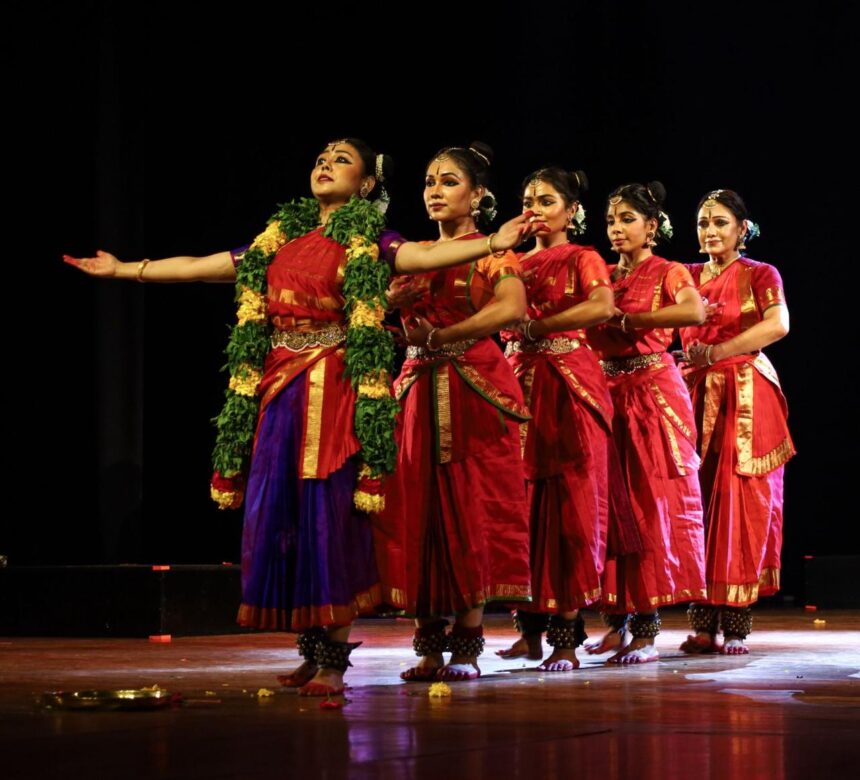
Hyderabad, January 20, 2026 On Sunday evening, Ravindra Bharati became a resonant space of devotion and quiet intensity as HCL Concerts presented “Maalyada – Andal’s Sacred Garland”, a Bharatanatyam dance adaptation conceived and choreographed by Rama Vaidyanathan. Based on the book by Jeysundhar D, with music composed by Sudha Raghuraman, the performance unfolded not as spectacle but as an inward journey, one that drew an attentive Hyderabad audience into shared stillness, non-stop for 80 minutes.
Rama Vaidyanathan is no longer spoken of in terms of promise or emergence; she is a maestro firmly at the height of her artistic authority. What she brought to the stage was not ornamentation but distilled wisdom, a dancer who allows silence, restraint, and suggestion to speak as eloquently as movement. The audience sensed this immediately. The hall was filled, yet remarkably hushed, with viewers leaning forward, immersed, following every glance, every pause, every measured step.
Rama Vaidyanathan’s Devotion Structured Through Nava Vidha Bhakti
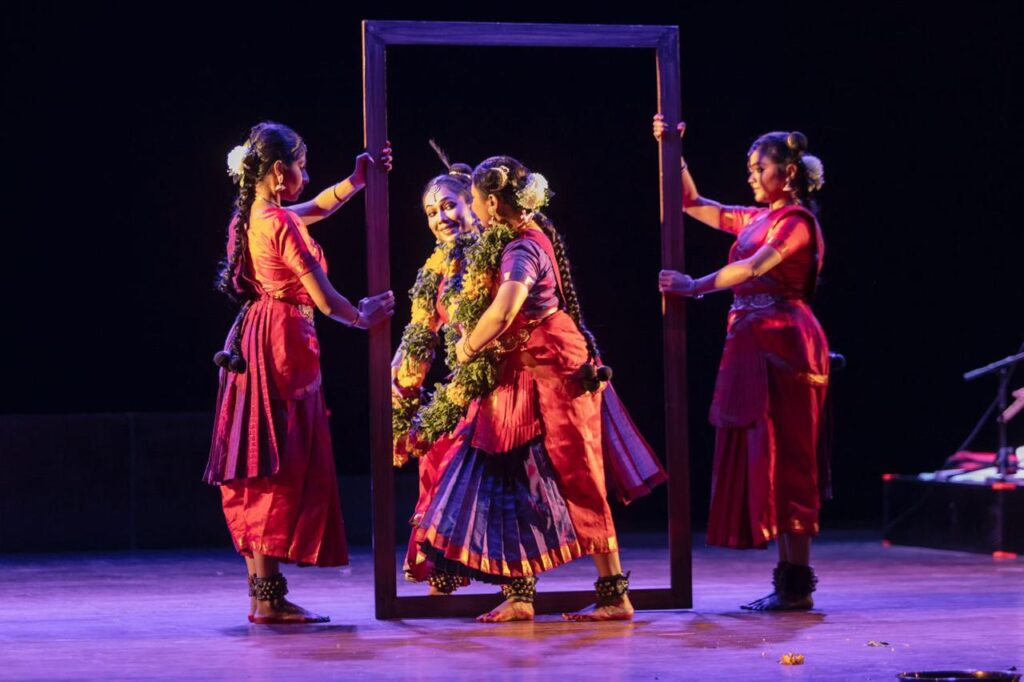
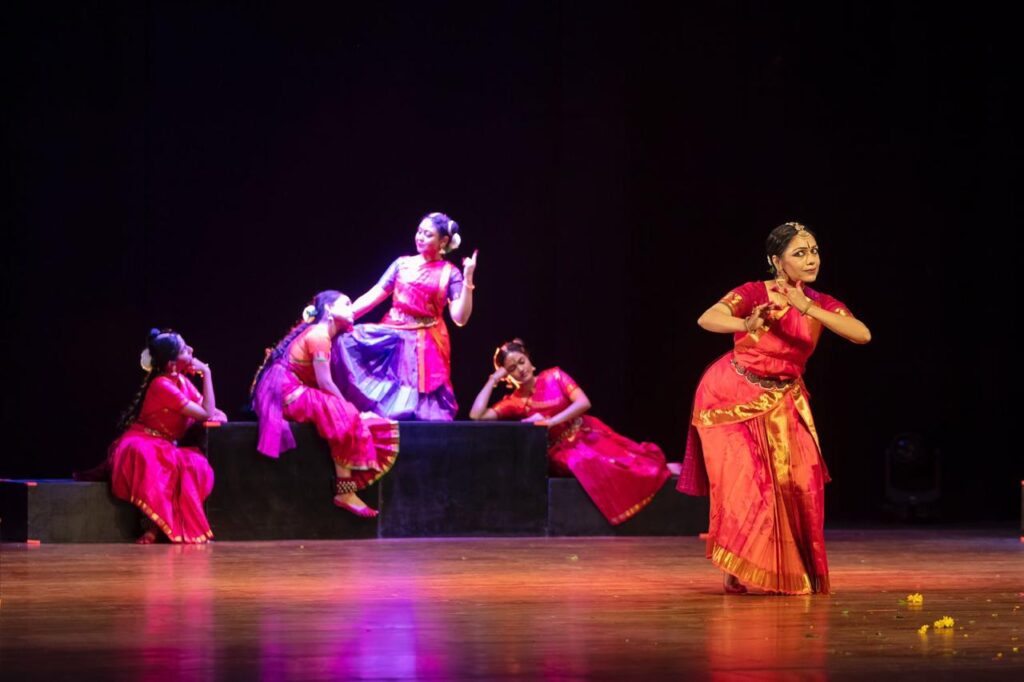
The conceptual spine of Maalyada lies in Nava Vidha Bhakti , the nine paths of devotion that chart a devotee’s gradual journey toward divine realisation. Rather than presenting these as discrete episodes, Rama wove them into a continuous emotional and spiritual arc, allowing Andal’s transformation to unfold organically.
The journey began with Shravanam (listening), where Andal absorbs the stories of the divine, followed by Smaranam(remembrance), as memory deepens into contemplation. Sankeerthanam (singing the divine) and Vandanam(salutation) brought outward expression to inner devotion, while Archanam (ritual worship) and Pada Sevanam (service at the divine feet) reflected humility and surrender. The emotional tenor shifted palpably with Sakhyam (friendship), where intimacy replaced awe, and Dasyam (servitude), marked by obedience and submission.
The culmination came with Atma Nivedanam, complete self-offering , where dancer and character dissolved into stillness, suggesting union rather than dramatizing it. The sequence was profound in its simplicity, trusting the audience to follow devotion not as theology, but as lived emotion.
A Dialogue Between Dancer and Ensemble
Integral to the impact of Maalyada was the deeply responsive musical ensemble, functioning not as accompaniment but as co-narrators of Andal’s journey.
Sudha Raghuraman’s vocal presence anchored the evening with remarkable emotional intelligence. Her singing carried the weight of bhakti without excess, allowing the sahitya to breathe. There was a rare balance of discipline and tenderness in her voice, aligning seamlessly with the choreographic intent.
On nattuvangam, Dr. Himanshu Srivastava demonstrated acute sensitivity to Rama’s phrasing and pauses. His rhythmic articulation framed the dance with precision, yet never imposed itself, allowing the narrative to unfold with clarity and calm authority.
Sumod Sreedharan’s mridangam provided a steady, nuanced rhythmic foundation. His playing responded instinctively to shifts in mood, restrained during introspective passages, quietly assertive during moments of resolve, reinforcing the internal rhythm of the story rather than driving it.
The melodic layer was enriched by G. Raghuraman on the flute, whose playing added a lyrical, almost breath-like quality to the soundscape. His phrases echoed Andal’s longing, often extending emotional moments beyond the physical movement on stage.
Visual and Technical Subtlety
The visual environment of Maalyada was crafted with restraint and purpose. Special effects by Sannidhi Vaidyanathan were sparingly used, enhancing the narrative without disrupting its contemplative mood. Surya Narayana Rao’s lighting design was particularly effective, using gentle shifts in tone and intensity to mark emotional transitions and devotional depth, rather than dramatic contrasts.
The Ensemble of Dancers
Dancers Reshika Sivakumar, Sayani Chakraborty, Shubhamani Chandrashekar, and Vaishnavi Dhore complemented Rama Vaidyanathan with disciplined presence and cohesion. Their movements expanded the emotional canvas without diluting the central narrative, functioning at times as extensions of Andal’s inner voice and at others as the collective world that surrounds her. Their synchrony and restraint reflected careful training and thoughtful choreography.
An Evening of Collective Immersion
What lingered long after the final moment of stillness was the sense of collective immersion. Applause arose naturally, not as interruption but as release. The standing ovation acknowledged not only technical mastery but the emotional honesty of the offering.
Maalyada reaffirmed Rama Vaidyanathan’s place as an artist who continues to deepen, refine, and challenge the Bharatanatyam stage, not by excess, but by trust in the power of devotion, form, and silence. For Hyderabad’s audience, it was not merely a performance, but an experience quietly carried home.
“Every performance is shaped by the space and the people in it. I thank HCL Concerts and Ravindra Bharati for this platform, but it was the audience’s attentiveness that carried the performance. Their energy made Maalyada feel less like a presentation and more like a shared moment of devotion.” said Rama Vaidyanathan after ending the show with and thunderous applause .