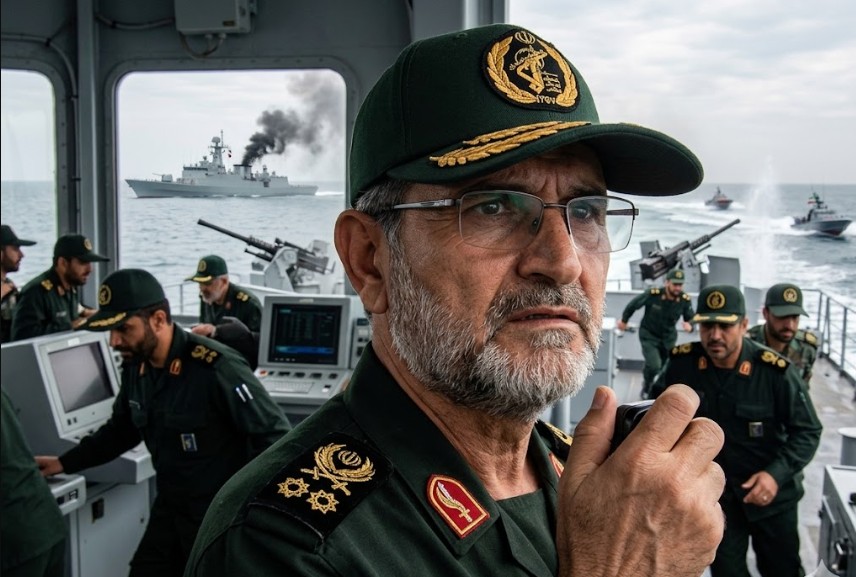
Thursday, March 26, 2026: JERUSALEM: In a crushing blow to Tehran’s maritime defiance, Israeli Defense Minister Israel Katz confirmed Thursday that a surgical air strike has successfully eliminated Alireza Tangsiri, the formidable commander of the Islamic Revolutionary Guard Corps (IRGC) Navy.
The high-value target was neutralized during a “precise and complex operation” conducted late Wednesday night. According to Israeli defense officials, the strike did not only claim Tangsiri but also decimated a gathering of senior naval command officers, effectively decapitating the leadership responsible for Iran’s asymmetric warfare in the Persian Gulf.
The Architect of Maritime Terror Alireza Tangsiri
Minister Katz, appearing in a video statement, characterized Alireza Tangsiri as the primary operative behind the “terrorist mining” and blockade of the Strait of Hormuz.
“The man directly responsible for holding global shipping hostage and threatening the artery of international trade has been blown up and eliminated,” Katz declared, underscoring the strategic weight of the mission.
The elimination of Alireza Tangsiri is the latest in a relentless “hunt-and-kill” campaign that has defined the United States-Israeli war on Iran, which ignited on February 28, 2026. Since the conflict’s inception, the Iranian hierarchy has been systematically dismantled. High-profile figures, including former Supreme Leader Ali Khamenei and security architect Ali Larijani, have already fallen to coalition strikes.
While Israeli intelligence celebrates the “total liquidation” of the naval wing, official confirmation from Tehran remains pending. Reporting from the Iranian capital, analysts suggest that if verified, this loss represents a catastrophic failure of internal security for a regime already reeling from the assassinations of Intelligence Minister Esmail Khatib and Basij paramilitary leader Gholamreza Soleimani.
A War on All Fronts
The strike in Bandar Abbas follows a week of unprecedented Israeli aggression against Iranian maritime assets. Just days ago, Israeli forces expanded the theater of war to the Caspian Sea, launching historic air raids that neutralized missile-equipped ships and patrol craft.
The message from Jerusalem remains uncompromising: the IRGC’s grip on the region’s waterways is being forcibly pried loose, one commander at a time.
Timeline of Key Assassinations (Feb 28 – March 26, 2026)
| Date | Figure | Role / Significance |
| Feb 28 | Ali Khamenei | Supreme Leader of Iran. Killed in a massive airstrike on his residence in Tehran on the opening day of the war. |
| March 12 | Unnamed Nuclear Scientists | Several top-tier Iranian nuclear scientists were reportedly targeted and killed in precision strikes. |
| March 16/17 | Ali Larijani | Secretary of the Supreme National Security Council. Often seen as the de facto leader and key powerbroker after Khamenei’s death. |
| March 17 | Gholamreza Soleimani | Commander of the Basij Force. Killed in a separate strike on the same night as Larijani. |
| March 18 | Esmail Khatib | Minister of Intelligence. His death was confirmed by President Pezeshkian as the third high-ranking official killed in a 48-hour window. |
| March 25/26 | Alireza Tangsiri | Commander of the IRGC Navy. Targeted for his role in the mining and closure of the Strait of Hormuz. |
Strategic Impact
This rapid sequence of strikes has created a “vacuum of experience” within the Iranian regime. Analysts suggest that by removing figures like Larijani, who was considered a more pragmatic negotiator, the path toward a diplomatic “off-ramp” has become significantly more narrow and complicated.