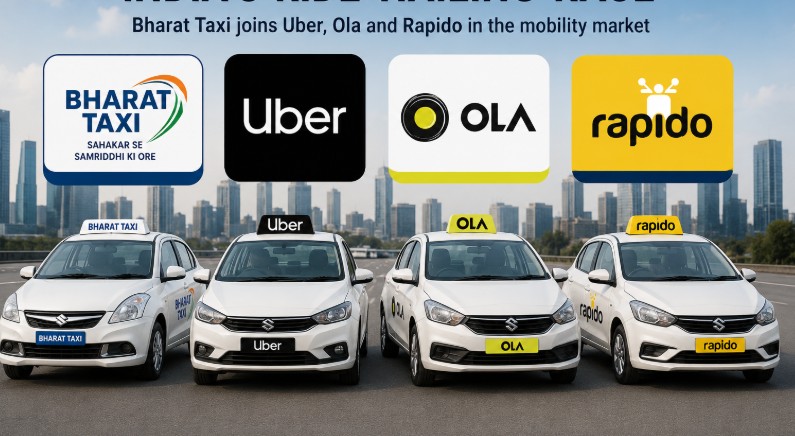
August 13, 2026: Bharat Taxi is taking its cooperative led mobility model deeper into India’s urban transport market, with services now officially launched across Delhi NCR, Gujarat, Maharashtra and Rajasthan.
Operated by Sahakar Taxi Cooperative Limited (STCL), the platform has registered 8.48 lakh drivers, known as Sarathis, and 44.27 lakh customers as of August 4, according to data shared by the government. The platform is currently facilitating 11,106 rides a day, with cumulative earnings of ₹83.70 crore generated for drivers.
Delhi NCR accounts for roughly half of the platform’s daily rides, recording 5,574 rides a day. Gujarat follows with 3,817 rides, while Pune records 632. Jaipur, Lucknow, Mumbai and Chandigarh contribute smaller volumes.
The numbers point to an early concentration of demand in a few urban markets, while the wider driver and customer base suggests Bharat Taxi is building its network ahead of a broader expansion.
The cooperative structure gives Bharat Taxi a different proposition in a market largely shaped by conventional ride hailing companies. Driver participation, cooperative membership and welfare form a central part of the operating model, potentially giving the platform a distinct positioning among drivers.
Bharat Taxi records 11,106 daily rides as nationwide rollout gathers pace
Scale, however, will remain the key test. A large registered base needs to translate into regular rides, stronger utilisation and sustained driver earnings for the model to establish itself across cities.
The government has said expansion into additional cities will depend on operational preparedness, driver availability, statutory requirements and coordination with state governments and cooperative institutions.
Bharat Taxi’s collaboration with West Bengal also points towards a partnership driven expansion strategy. Under an MoU signed with the West Bengal government on July 19, STCL will support the Yatri Sathi platform in driver enrolment, cooperative membership, driver welfare and public outreach.
For India’s mobility market, the Bharat Taxi rollout adds another model to the evolving transport ecosystem. The larger question now is whether a cooperative structure can combine driver participation with the reliability, availability and scale expected from a mainstream urban mobility platform.