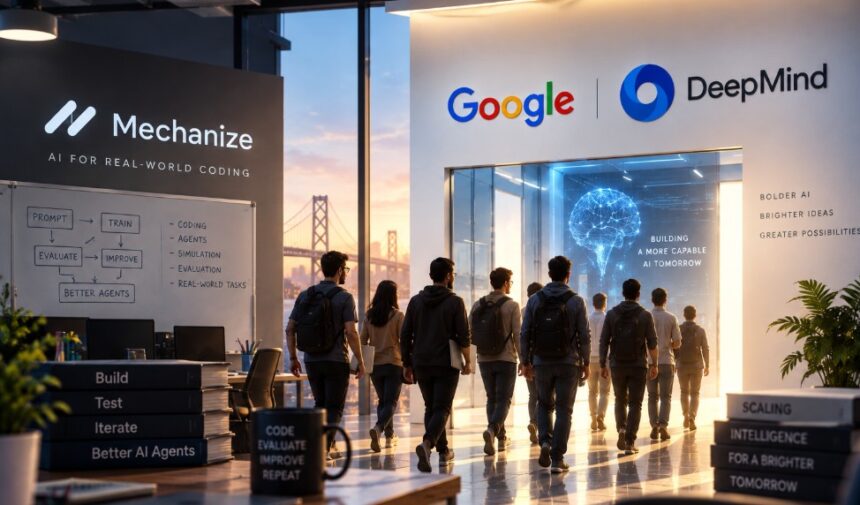
September 14, 2026: Google has completed its deal with San Francisco-based AI startup Mechanize, bringing the startup’s co-founder and former CEO Tamay Besiroglu into Google DeepMind as a research scientist.
The move also brings a larger group of Mechanize employees into Google. More than a dozen former employees have reportedly joined the tech giant, with several now working on AI model development, including efforts around “midtraining.”
The deal is notable not simply because of the people moving to Google, but because of the area in which Mechanize was building.
Mechanize was focused on improving the ability of AI systems to handle complex software-engineering tasks. Rather than building another consumer-facing AI product, the startup worked on environments and systems designed to train and evaluate AI agents as they tackle coding problems.
That is becoming an increasingly important part of the AI race. The industry is moving from models that can generate snippets of code to AI agents that can take on longer, more complicated assignments. These systems need to understand a codebase, make changes, test them, identify errors and continue working until a task is completed.
For companies developing frontier AI models, measuring whether an agent can actually accomplish that work is becoming almost as important as generating the model itself.
This is where Mechanize’s expertise becomes particularly relevant to Google. The company had raised $9.1 million earlier this year at a reported valuation of $500 million. Google had subsequently been reported to be discussing a technology-and-talent deal worth more than $1.5 billion, although the final terms of the completed arrangement have not been disclosed.
$500M Valuation to Google: The Mechanize AI Story
The reported numbers underline how quickly valuations can move in specialised areas of artificial intelligence. Mechanize was a relatively small startup, but it was working on a problem that sits close to the centre of the next phase of AI development.
There is also an interesting difference between this deal and a conventional startup acquisition. Mechanize has not simply disappeared into Google. Former chief of staff Guive Assadi now lists himself as the company’s CEO, while Besiroglu and a significant portion of the team have moved to Google.
For Google, the arrangement provides access to specialised talent and technology without necessarily requiring the traditional playbook of absorbing an entire startup.
The timing is important. Google, OpenAI and Anthropic are all pushing aggressively into AI coding and autonomous software-development tools. As these systems become more capable, the competitive advantage is shifting toward the ability to train agents to perform useful tasks reliably rather than simply producing impressive demonstrations.
Google has made similar moves in the past. The company previously brought talent from AI coding startup Windsurf into its organisation, with former Windsurf CEO Varun Mohan later taking a leadership role in Google’s agentic coding efforts.
Mechanize adds another piece to that strategy. For startups, the bigger takeaway may be that the most valuable AI businesses are not necessarily the ones with the largest user bases.
A small company solving a difficult technical problem , whether in model training, evaluation, data, AI agents or infrastructure ,can become strategically important to a technology giant if that capability becomes a bottleneck for the next generation of AI.
Mechanize appears to have positioned itself in precisely that part of the market. The AI race is no longer only about who can build the biggest model. Increasingly, it is about who can make those models perform difficult work better, for longer and with fewer failures.
And that is what makes Google’s interest in Mechanize worth watching.