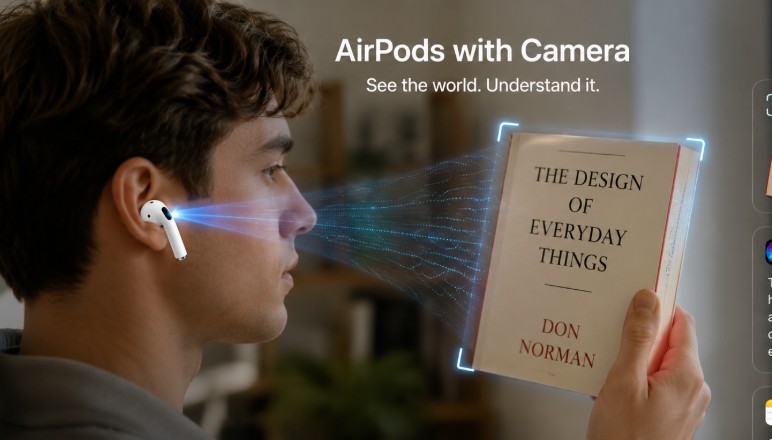
August 18, 2026: Apple appears to be moving closer to a new category of wearable computing: AirPods equipped with cameras that can understand the environment around the wearer.
According to details reported by MacRumors, references to an unreleased Apple product codenamed B790 have appeared in macOS Tahoe 26.7, including a short demonstration that appears to show how camera-equipped AirPods could work with Apple’s Visual Intelligence and Siri.
The development is significant because it moves AirPods beyond their traditional role as audio accessories. Instead, they could become another set of sensors through which Apple’s AI understands the physical world.
In the demonstration reported by MacRumors, a person holds up a book so that the camera on the AirPods can see its title. Visual Intelligence can then use that information, with Siri positioned to answer questions about the wearer’s surroundings or record information for later use.
That seemingly simple interaction illustrates where Apple may be heading: computing that does not require users to take out a phone, point a camera or deliberately open an application.
Apple’s AirPods May Soon See the World, But Who Else Gets to See It?
Instead, the AI could be available through a device already being worn.
The technology could have obvious practical applications. A user could potentially ask Siri to identify an object, remember something they saw, provide contextual information about a location or assist with visual tasks. For people with accessibility needs, hands-free visual assistance could be particularly valuable.
It could also change everyday productivity. Imagine walking through a store and asking an AI assistant to remember a product, reading information from packaging without reaching for a phone, or asking about something encountered during travel.
Apple’s Visual Intelligence framework is already designed around understanding information from the user’s surroundings, while Apple is increasingly integrating its AI capabilities across its devices and operating systems.
But putting the camera into AirPods introduces a fundamentally different privacy challenge.
A smartphone camera is conspicuous. When someone raises a phone, people around them generally understand that a camera may be pointed in their direction.
A camera embedded in a small wearable is less obvious. That distinction matters.
The AirPods could be worn while walking, shopping, attending meetings or interacting with other people. If the device can continuously or frequently interpret what is around the wearer, people in that environment could become part of the AI system’s visual context without necessarily knowing it.
MacRumors also found a reference indicating that users could be alerted if hair is covering the AirPods because the cameras need an unobstructed view to provide accurate information.
That detail is revealing. The camera is not simply an experimental feature hidden inside the hardware. The software appears designed to actively depend on the cameras seeing the user’s environment.
The larger question, therefore, is not simply whether Apple can make camera-equipped AirPods useful. It is whether the company can establish clear boundaries around when they see, what they process, where information goes and how other people know they are potentially being recorded or analysed.
Apple is not entering this territory alone. Meta has already pushed camera-equipped wearables into the mainstream conversation through its smart glasses. Apple’s entry could therefore accelerate a much larger transition: from smartphones that users deliberately operate to ambient computing systems that are increasingly aware of their surroundings.
That could ultimately be more important than the AirPods themselves. For years, technology has been moving from desktop computers to laptops, smartphones, smartwatches and earbuds. The next stage could be devices that increasingly combine sensors, artificial intelligence and context.
The benefit is obvious: less friction. The risk is equally obvious: less awareness of when technology is observing us. This is where Apple will need to distinguish convenience from intrusion.
Clear recording indicators, meaningful consent mechanisms, strong on-device processing where possible, transparent data policies and controls over what Visual Intelligence can retain will become increasingly important.
The reported B790 AirPods could launch as early as September, according to the timeline previously suggested by Bloomberg’s Mark Gurman, although Apple has not confirmed the product or its launch plans.
If they do arrive, the headline feature may be described as a camera. The bigger story is AI that can see.
And that could mark a significant step toward a world where our digital assistants do not simply hear what we say, they understand what is happening around us.
That future could be remarkably useful. But it will also require society to establish new rules for privacy in spaces where cameras are no longer obvious, occasional devices, but part of what people wear every day.